
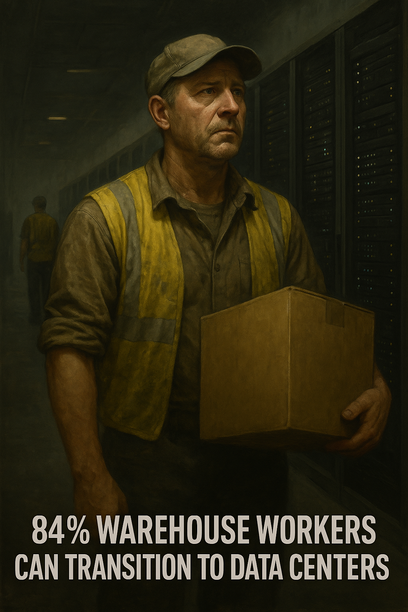
How 200 warehouse workers became $85K data center specialists in 60 days
The greatest career transformation story I’ve witnessed happened in Ohio last fall.
Midwest Logistics faced automation displacement. 200 warehouse workers were looking at layoffs as robots took over picking and packing operations.
But their HR director saw something everyone else missed.
The same workers who maintained conveyor systems, monitored HVAC equipment, and troubleshot automation breakdowns for 8-12 hour shifts… were exactly what hyperscale data centers desperately needed.
Here’s what they discovered:
**84% of warehouse automation workers had directly transferable skills:**
• Cooling system expertise (warehouse climate control = data center thermal management)
• 24/7 operations mindset (shift work translates perfectly)
• Mechanical troubleshooting (conveyor systems = server rack maintenance)
• Safety protocols (industrial environments require same precision)
• Real-time monitoring (warehouse dashboards = data center NOCs)
**Their 60-day transformation framework:**
Week 1-2: Skills assessment and competency mapping
Week 3-6: Micro-certifications in data center fundamentals
Week 7-8: Hands-on training at partner facilities
Week 9+: Graduated placement with continued mentorship
**The results shocked everyone:**
✅ 89% completion rate (178 out of 200 workers)
✅ $28K average salary increase ($57K to $85K)
✅ 96% retention after 12 months
✅ Zero layoffs—every worker who wanted transition got it
✅ $4.2M in total wage increases for their community
But here’s the breakthrough moment:
Three months later, AWS approached them to be their exclusive Midwest staffing partner for new data centers. Why? They were the only agency that could guarantee qualified, retention-proven infrastructure workers at scale.
Their warehouse ‘problem’ became their biggest competitive advantage.
Today, they’re placing 40+ workers monthly into $75K-$95K data center roles across 6 states. Former forklift operators are now senior cooling technicians. Warehouse supervisors lead data center infrastructure teams.
The lesson isn’t just about career transitions.
It’s about recognizing that industrial experience isn’t obsolete—it’s the foundation for high-tech advancement when you map skills strategically.
Every automation ‘displacement’ is actually a workforce ‘elevation’ opportunity waiting to happen.
Which industrial workers in your network could be tomorrow’s data center specialists?