
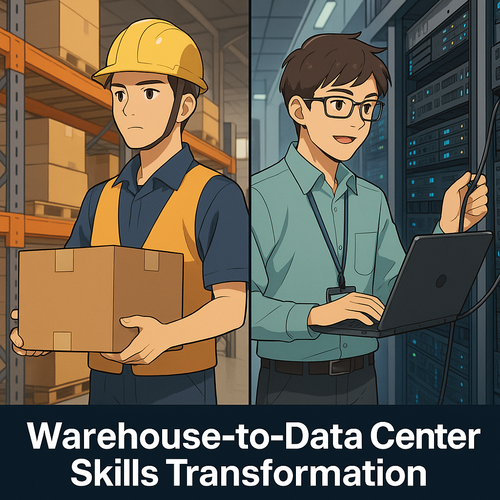
How 127 warehouse workers became data center specialists in 90 days
Everyone said it was impossible.
When automation threatened 127 warehouse jobs at Midwest Logistics Solutions, conventional wisdom suggested layoffs, retraining programs, or early retirement packages.
But CEO Sarah Chen saw something others missed.
She noticed her warehouse automation technicians possessed nearly identical skills to what hyperscale data centers desperately needed:
• 24/7 operations experience with zero tolerance for downtime
• Mechanical troubleshooting under extreme time pressure
• Automated systems monitoring and rapid response protocols
• Cooling system maintenance and temperature optimization
• Power distribution understanding and electrical safety
Instead of letting go of talent, she partnered with three regional data center operators to create the industry’s first Warehouse-to-Data-Center Skills Bridge Program.
The 90-day transformation protocol included:
**Phase 1 (30 days)**: Skills mapping and competency validation
**Phase 2 (30 days)**: Data center-specific technical training
**Phase 3 (30 days)**: On-site deployment with mentor support
The results shocked everyone:
✅ 89% successful completion rate (113 of 127 workers)
✅ Average salary increase of $18,000 per worker
✅ 96% retention rate after 12 months
✅ $4.2M in total annual wage increases for participating workers
✅ Zero unemployment claims from automation displacement
But the real breakthrough came when data center operators started competing for these workers.
Why? Because warehouse automation specialists brought something university-trained technicians often lacked: **real-world crisis management experience**.
When a cooling system fails at 2 AM, you don’t need theory. You need someone who’s solved urgent equipment problems under pressure—exactly what warehouse workers do daily.
Sarah’s company now runs the region’s most successful data center staffing pipeline, with a 6-month waiting list of workers wanting skills transformation.
The lesson? Don’t see automation as job destruction. See it as skills evolution.
Your warehouse workers aren’t becoming obsolete—they’re becoming exactly what the digital infrastructure world desperately needs.
Which of your ‘displaced’ workers could become tomorrow’s most valuable data center specialists?