
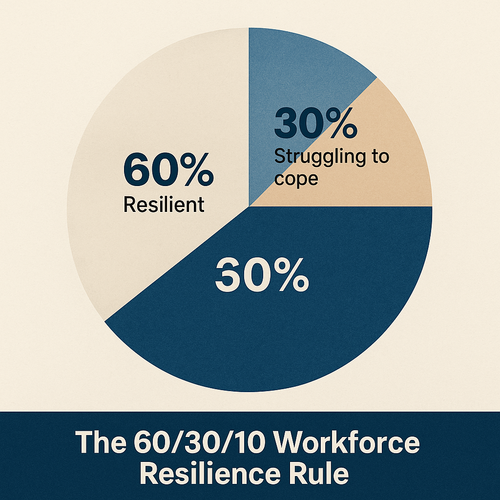
The 60/30/10 rule that future-proofs your workforce during automation
Technological disruption is inevitable. Workforce resilience is not.
While competitors scramble during automation waves, smart organizations use the 60/30/10 Workforce Resilience Framework to turn disruption into competitive advantage.
Here’s how it works:
**60% Technology-Adaptable Core Staff**
These are your versatile professionals who combine foundational skills with learning agility. They’re warehouse workers who understand both manual processes and automation systems, or data center technicians comfortable with traditional infrastructure and AI workloads. They form your stable foundation during transitions.
**30% Specialized Technical Experts**
Your deep specialists who drive current operations—the cybersecurity architects, industrial automation engineers, and cooling systems experts. They optimize today’s systems while helping evaluate tomorrow’s technologies. Critical for maintaining performance during changeover periods.
**10% Emerging Skills Pioneers**
Your innovation scouts—professionals experimenting with quantum computing, advanced robotics, or next-generation manufacturing. They might be part-time researchers, contractor specialists, or internal employees with R&D time. They spot opportunities and prepare your organization for the next disruption.
This isn’t about headcount—it’s about capability distribution.
We’ve seen manufacturing companies using this framework navigate automation deployment with 94% workforce retention while competitors faced 40% turnover. Data center operators applied it during AI infrastructure transitions, reducing training costs by 67% while maintaining 99.9% uptime.
The magic happens when disruption hits:
• Your 60% adapts quickly because they were hired for learning ability
• Your 30% bridges old and new systems during transition periods
• Your 10% already understands emerging technologies, eliminating knowledge gaps
Most organizations build teams for today’s challenges. Winners build teams for tomorrow’s opportunities.
The 60/30/10 framework transforms workforce planning from reactive hiring into strategic capability architecture. It turns technological change from a threat into a sustainable competitive advantage.
Because in rapidly evolving industries, workforce resilience isn’t just about surviving disruption—it’s about thriving because of it.
Which part of your workforce composition needs rebalancing for the next technology wave?