
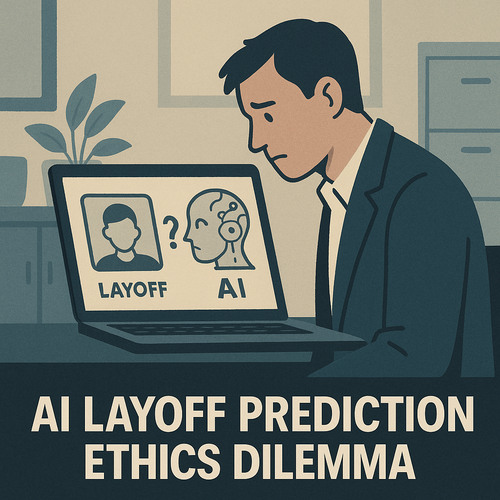
AI now predicts layoffs 12 months early—but should employees know?
This isn’t science fiction. It’s happening right now at Fortune 500 companies.
Advanced workforce optimization AI can identify which employees will likely be laid off 6-12 months before executives even begin planning reductions. These systems analyze productivity metrics, project allocation patterns, skill relevance scores, and team dynamics to predict workforce ‘optimization opportunities’ with 89% accuracy.
Here’s what’s actually being measured:
• Individual productivity trends vs. team benchmarks
• Skills gap analysis against future project requirements
• Collaboration network position and influence scores
• Training engagement and adaptability indicators
• Cost-per-output ratios compared to market alternatives
The ethical dilemma is staggering.
Employees continue working, building relationships, and planning futures while algorithms have already flagged them for elimination. Some companies use this data for ‘compassionate transitions’—gradually shifting responsibilities, offering retraining, or encouraging voluntary departures.
But others simply optimize their layoff timing and messaging.
The uncomfortable questions:
**Should employees know when AI has flagged them?** Transparency could help with career planning but might destroy morale and productivity.
**Is algorithmic workforce planning inherently dehumanizing?** These systems treat people as data points in optimization equations.
**What happens to loyalty and engagement** when workers discover their employer has been algorithmically planning their exit?
**Who’s accountable for AI bias?** These systems may discriminate against older workers, parents, or employees with disabilities without human awareness.
For staffing professionals and HR leaders, this technology represents both opportunity and responsibility. The predictive power can enable smoother workforce transitions and better planning. But it also demands unprecedented ethical frameworks.
The companies implementing these systems argue they’re being responsible—using data to make difficult decisions more thoughtfully. Critics counter that this represents the ultimate surveillance capitalism, where human careers become algorithmic optimization problems.
As this technology spreads, your organization will need clear policies on:
– Transparency requirements for AI workforce decisions
– Employee rights regarding algorithmic career impact
– Bias detection and human oversight protocols
– Ethical boundaries for predictive workforce analytics
The genie is already out of the bottle. The question isn’t whether AI will reshape workforce planning—it’s whether we’ll do it with humanity intact.
Where do you draw the ethical line? Should employees have the right to know when algorithms are evaluating their career sustainability?