
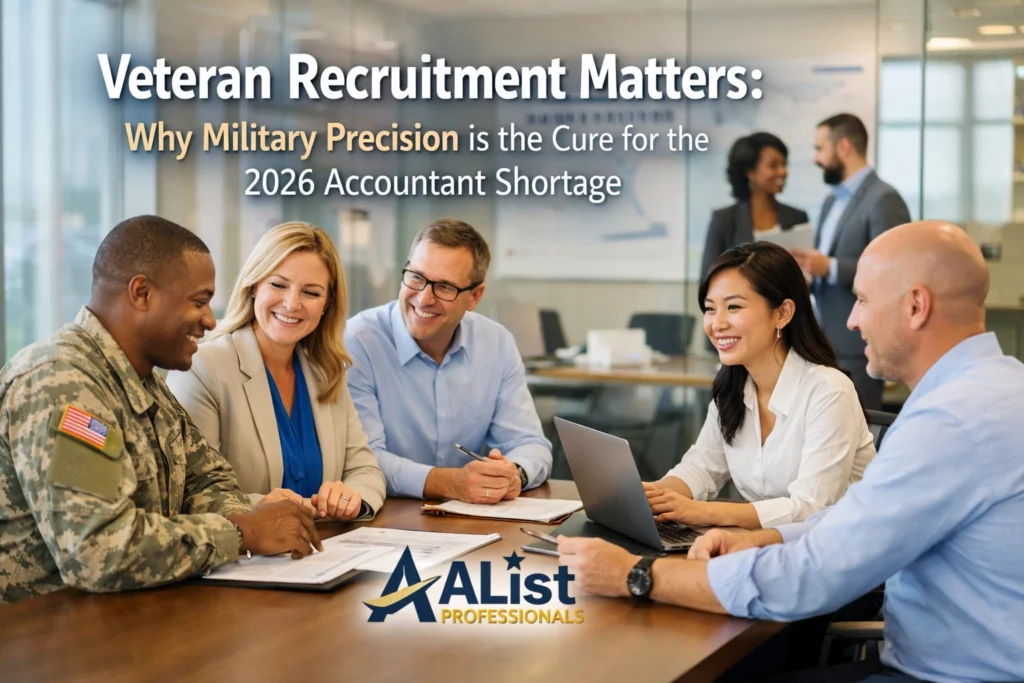
As we navigate the first quarter of 2026, the accounting industry is facing a reckoning that has been brewing for nearly a decade. For years, experts warned of a "talent cliff," but today, that cliff is our daily reality. With accounting graduates down 30% from their peak and a staggering wave of Baby Boomer retirements leaving senior roles vacant, firms and corporate finance departments are scrambling to maintain the integrity of their financial reporting.
At AList Professionals, we’ve spent years tracking these trends. The shortage isn't just about a lack of bodies in seats; it’s about a lack of precision. In an era of complex tax codes, global compliance standards, and high-stakes auditing, a "close enough" attitude doesn't cut it.
To solve the 2026 accountant shortage, we don’t just need more people; we need a different kind of professional. We need individuals who are hardwired for discipline, trained in high-pressure environments, and committed to absolute accuracy. This is why AList Professionals is doubling down on our core mission: bridging the gap between the military veteran community and the professional world of finance.
The State of the 2026 Talent Gap
The numbers are sobering. The American Institute of Certified Public Accountants (AICPA) has noted that the pipeline for new CPAs remains constricted. Meanwhile, the demand for accounting jobs has surged as businesses face more rigorous regulatory environments and the need for data-driven financial storytelling.
Traditional recruitment methods are failing because they rely on a dwindling pool of traditional candidates. Firms are outbidding each other for the same five candidates, leading to inflated salaries without necessarily seeing a corresponding increase in quality or longevity.
This is where the military-to-accounting pipeline becomes a strategic necessity rather than just a diversity initiative.

Why Military Precision is the Perfect Fit for Finance
When people think of military veterans, they often think of technical roles, security, or logistics. While those are certainly valid, the core competencies required to succeed in the Armed Forces are the exact same competencies required to excel in modern financing jobs.
1. Discipline and Rigor
Accounting is, at its heart, a discipline of rules. Whether it’s GAAP (Generally Accepted Accounting Principles) or IFRS (International Financial Reporting Standards), there is a right way and a wrong way to do things. Veterans are trained from day one to operate within rigorous frameworks. In the military, following protocol isn't a suggestion: it's a matter of mission success and safety. When that mindset is applied to a general ledger, the result is a level of accuracy that is increasingly rare in the civilian market.
2. High-Pressure Decision Making
Closing the books during a volatile fiscal year or navigating a complex audit can be incredibly stressful. Veterans are uniquely conditioned to handle pressure. They have managed multi-million dollar equipment manifests, directed complex logistical movements, and maintained composure in environments far more chaotic than a corporate boardroom. An accountant who doesn't panic when the numbers don't reconcile at 11:00 PM on a Friday is an invaluable asset.
3. Ethical Integrity
The accounting profession is built on trust. One ethical lapse can ruin a firm’s reputation or lead to massive compliance risks. The military operates on a strict code of ethics and personal accountability. For a veteran, integrity is a foundational character trait. Hiring a veteran means hiring someone who understands the weight of responsibility and the importance of transparent reporting.
AList Professionals: An SDVOSB Perspective
Our commitment to veteran recruitment isn't just a business strategy; it's our identity. AList Professionals is a Service-Disabled Veteran-Owned Small Business (SDVOSB). Our leadership, including CEO Levi Hunter, understands firsthand the incredible value that transitioning service members bring to the private sector.
We don’t just look at a resume; we look at the person. We know how to translate military occupational specialties (MOS) into corporate competencies. When we see a veteran who managed a unit's budget or handled complex logistics in a combat zone, we don’t just see "military experience": we see a high-level project manager with a penchant for accounting jobs.

Our status as an SDVOSB also allows us to offer unique advantages to our clients. Partnering with a veteran-owned firm helps corporations meet their diversity and inclusion goals while simultaneously accessing a talent pool that is often overlooked by traditional recruiters. You can learn more about our specific approach on our employers page.
Solving the Analytical Gap with Military Minds
In 2026, accounting is no longer just about data entry. It’s about data analysis. With AI handling much of the rote calculation, the modern accountant must be an analyst who can spot trends, identify risks, and offer strategic advice.
Military training emphasizes "situational awareness." Soldiers are taught to look at a field of data, identify what is relevant, and predict what might happen next. This "intelligence-led" approach is exactly what modern CFOs are looking for. Veterans don't just report numbers; they look for the story behind the numbers. They look for the "why" behind a budget variance and the "how" of mitigating future risks.
Beyond the Numbers: The Cultural Impact
The accountant shortage of 2026 has led to high turnover rates as professionals jump from firm to firm for marginal salary increases. Veterans, however, tend to exhibit higher levels of loyalty and commitment to a mission. If they believe in the company’s goals and feel their work is valued, they are often more stable hires than their civilian counterparts.
By integrating veterans into your finance team, you aren't just filling a vacancy; you are infusing your culture with a sense of mission and teamwork. These are individuals who understand that their individual success is tied to the success of the unit: or in this case, the company.

How AList Professionals Bridges the Gap
Recruiting veterans for professional roles requires more than just a "we hire heroes" banner. It requires a deep understanding of the transition process. Many veterans struggle to articulate how their military experience applies to a corporate finance setting, and many hiring managers don't know what questions to ask to uncover that potential.
At AList, we act as the bridge. Our veteran career opportunities portal is designed specifically to help service members find their footing in roles where their precision can shine. We offer a 3-phase upskilling framework that ensures candidates have the specific technical nuances of 2026-era accounting tools combined with their existing leadership skills.
We also assist AList clients in building veteran-friendly onboarding programs. It’s not enough to hire a veteran; you have to create an environment where their unique skills are leveraged effectively.
The Strategic Path Forward
As the 2026 fiscal year continues to challenge even the most established organizations, the question isn't whether you can afford to hire veterans: it's whether you can afford not to. The "talent cliff" is real, but it is not insurmountable.
The cure for the accountant shortage isn't simply finding more people who can use Excel. It’s finding people who understand that every decimal point matters, every deadline is a mission-critical objective, and every financial report is a testament to the organization's integrity.
If your organization is struggling to find the talent you need in accounting, engineering, or IT, it’s time to look toward the veteran community. With military precision on your side, the "shortage" becomes an opportunity to build a stronger, more resilient team than you ever thought possible.
Are you ready to strengthen your finance team with the discipline of the military? Explore our services or contact us today to learn how AList Professionals can help you secure the talent that others are missing. The precision your business deserves is just one veteran hire away.