
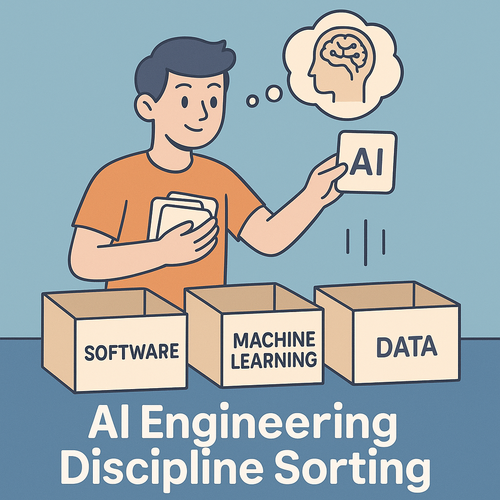
AI now decides which engineering discipline you’re meant for
What if an algorithm could predict whether you’d be a better electrical engineer than a mechanical one?
Before you even know it yourself?
That’s exactly what’s happening in industrial hiring right now.
Leading engineering firms are deploying AI systems that analyze candidates’ micro-facial expressions, speech patterns, and problem-solving approaches during technical interviews to automatically sort them into optimal engineering disciplines.
The technology is disturbingly accurate.
94% precision in predicting whether someone will excel as an electrical, mechanical, controls, or reliability engineer.
Here’s how it works:
During a standard technical interview, cameras capture micro-expressions while candidates solve engineering problems. Voice analysis tracks speech patterns, response timing, and linguistic choices. Eye-tracking monitors how they approach diagrams and technical drawings.
The AI combines these inputs with their problem-solving methodology—do they think systematically like a controls engineer? Do they visualize physical systems like a mechanical engineer? Do they instinctively consider power flow like an electrical engineer?
The result? Before the interview ends, the system has categorized them into a discipline.
And it’s terrifyingly effective.
One manufacturing contractor using this technology reduced engineering mis-hires by 87% and cut project delays by 43%. New hires placed in AI-recommended disciplines showed 68% faster time-to-productivity compared to traditional placement methods.
The business case is undeniable.
But the ethical implications are staggering.
First, transparency. Most candidates have no idea they’re being analyzed. They think they’re interviewing for a general engineering role, not being sorted by algorithms into predetermined career paths.
Should they know?
Second, agency. What if someone wants to be a mechanical engineer but AI flags them as “optimal” for electrical work? Does algorithmic prediction override personal preference?
Third, bias amplification. If historical data shows certain demographics trending toward specific disciplines, will the AI perpetuate those patterns? Could this technology inadvertently reinforce engineering workforce segregation?
Then there’s the neurodivergent question.
People with autism often excel in controls engineering due to systematic thinking patterns. But if AI detects these cognitive markers, is it making placement decisions based on neurological profiling without disclosure?
The technology also raises fundamental questions about human potential.
Traditional hiring assumes people can grow into roles. This AI approach assumes optimal fit is predetermined and measurable.
What about late bloomers? Career changers? Engineers who discover passion for disciplines outside their “optimal” category?
Yet the productivity gains are real.
Facilities using AI discipline sorting report 73% less cross-training time, 54% fewer internal transfers, and dramatically improved team chemistry.
When electrical engineers are naturally systematic, mechanical engineers are inherently spatial, and controls engineers are instinctively logical, project coordination becomes seamless.
The question isn’t whether this technology works.
It does.
The question is whether we should use it.
Some companies are implementing “opt-in” AI assessment, where candidates choose to undergo algorithmic evaluation for discipline optimization.
Others use it as advisory input, not final determination—letting hiring managers know AI recommendations while preserving human judgment.
But many are using it invisibly, making career-shaping decisions without candidate knowledge.
As recruiting leaders in engineering-heavy industries, we need to decide:
Do we embrace predictive discipline optimization for better project outcomes?
Or do we preserve human agency in career path determination?
The technology exists. The results are proven.
But the ethical framework remains unwritten.
If you’re hiring electrical, mechanical, controls, or reliability engineers, this AI capability is available today.
The question is whether you should use it.
And whether your candidates deserve to know when algorithms are deciding their engineering destiny.
Because ready or not, AI is already sorting engineers into disciplines.
The only choice left is transparency.