
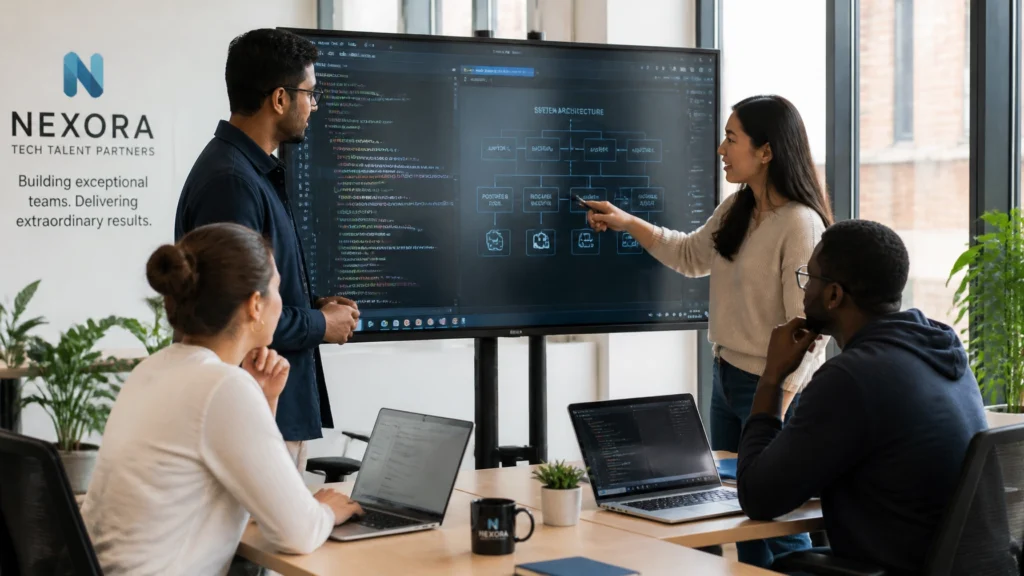
If you feel like the software development recruitment landscape has shifted beneath your feet over the last year, you’re not alone. Welcome to mid-2026, where the "hiring freezes" of the early 2020s have thawed, but the ground we're walking on looks entirely different.
At AList Professionals, we’ve spent over 30 years navigating the ebbs and flows of technical staffing. Whether we’re placing a Senior Cloud Architect or a specialized Data Engineer, one thing is clear: the "spray and pray" method of job postings is officially dead. In its place is a highly surgical, outcome-based approach to finding talent.
If you’re a hiring manager or a business leader looking to scale your engineering team this year, here are the 10 critical things you need to know about the 2026 market.
1. The "Barbell" Market: Seniors are Gold, Juniors are Squeezed
The most striking trend in 2026 is the widening gap between entry-level and senior roles. While overall tech hiring is up roughly 20% at top-tier firms compared to last year, that growth is almost entirely concentrated at the senior and specialist levels.
Entry-level postings have seen a significant drop: down nearly 46% in some sectors. Why? Because generative AI tools have automated many of the "boilerplate" tasks that used to be the bread and butter of junior developers. Companies are now looking for "high-impact builders" who can oversee AI-generated code rather than just writing it.
2. AI Fluency is the New "Requirement"
In 2026, listing "AI experience" on a resume isn't just a bonus; it’s a baseline expectation. However, we aren't just talking about building chatbots. The demand has shifted toward engineers who understand AI Infrastructure and integration.
Employers are prioritizing candidates who can review, direct, and audit AI-generated output. There is a deep focus on the ethics of AI job displacement and how to use these tools to augment human creativity rather than replace it. If your recruitment process doesn't test for AI collaboration, you're hiring for 2022, not 2026.

3. The Pivot to Skills-Based Hiring
The era of the "pedigree" hire: where a specific degree or a stint at a FAANG company guaranteed a job: is fading. In 2026, we are seeing a massive shift toward skills-based hiring.
This is something we’ve championed at AList Professionals for a long time, particularly through our work with federal skills-based hiring initiatives. Companies are now using practical assessments and work trials to prove competency. They want to see what you can do, not just where you went. This approach is also helping to bridge the gap for veterans and those from nontraditional backgrounds, a core part of our mission as a minority-owned firm.
4. Python and the "Big Four" Still Rule
Despite the constant churn of new frameworks, the core technical stack remains remarkably stable. As of mid-2026, Python remains the most in-demand language, appearing in nearly 46% of all technical job postings.
The "Big Four": Python, JavaScript, TypeScript, and Java: continue to dominate the enterprise landscape. However, the way these languages are used has changed. Recruiters are no longer looking for a "Python Developer"; they are looking for a "Problem Solver who uses Python to build scalable AI pipelines."
5. The Rise of the Infrastructure Specialist
As more companies move beyond basic cloud migration and into "Cloud Native" architecture, the demand for infrastructure specialists has skyrocketed. We call this the infrastructure skills bridge strategy.
The market is currently facing a significant shortage of talent capable of managing complex, multi-cloud environments and quantum-ready infrastructure. If you are looking to hire in this space, expect to pay a premium. The fully loaded cost of a senior US-based infrastructure engineer now regularly exceeds $250,000.

6. Cybersecurity is No Longer a "Department"
In 2026, security is everyone’s job. Recruitment for generalist software engineers now almost always includes a "Security First" mindset assessment. With the rise of AI-driven cyber threats, companies are looking for developers who understand DevSecOps from day one.
Roles in cybersecurity, data reliability, and observability are among the fastest-growing categories this year. If your recruitment strategy isn't highlighting your commitment to a secure development lifecycle, you'll struggle to attract the top 10% of talent who want to work in mature environments.
7. Global and Nearshore Strategies are Expanding
The logistical hurdles of domestic hiring: including the "legal coin flip" of the H-1B visa process: have pushed more US companies toward global and nearshore strategies.
We are seeing a massive increase in companies building specialized engineering hubs in Latin America and Eastern Europe. This allows firms to find senior talent in time zones that align with the US, without the immigration headaches. At AList, we support this through our national reach and collaborative partner process, ensuring that whether a hire is local or remote, they fit the culture and the mission.
8. The Death of the "LeetCode" Interview
For years, the industry relied on "LeetCode" style algorithm drills to vet candidates. In 2026, that trend is finally dying. Why? Because AI can solve those puzzles in seconds.
Modern recruitment is shifting toward System Design and Work Trials. Employers want to see how an engineer thinks about architecture, how they handle a "broken" production environment, and how they collaborate with a team.

9. Outcome-Based Staffing Over "Body-Shop" Recruiting
The transactional nature of staffing is being replaced by what we call Staffing Intelligence. Companies are no longer looking for "three resumes by Monday." They are looking for staffing partners who understand their business outcomes.
Are you trying to reduce technical debt? Are you trying to launch a new AI product in 90 days? Your recruitment partner should be asking these questions. At AList, we focus on outcome-based solutions that streamline the hiring process and maximize your cost savings.
10. Managing the Multi-Generational Engineering Team
Finally, 2026 has brought the most diverse workforce in history: not just in terms of background, but in terms of age. We are seeing Gen Z "AI Natives" working alongside seasoned Gen X architects who remember the first dot-com bubble.
Managing this mix requires a specific framework for multi-gen workforce optimization. Successful recruitment in 2026 means finding talent that can bridge these generational gaps, combining the institutional knowledge of veterans with the rapid-fire innovation of the younger generation.

The AList Professionals Difference
Navigating the 2026 software development market doesn't have to be a headache. Whether you’re a small business looking for your first senior hire or a large enterprise scaling an entire DevOps team, we’re here to help.
We specialize in diversity and veteran recruitment, ensuring that your team isn't just technically capable, but brings a range of perspectives that drive innovation. Our collaborative "partner process" ensures that we find the right fit the first time, saving you time and resources.
Ready to find your next top-tier developer?
Contact AList Professionals today and let’s build something great together.
