
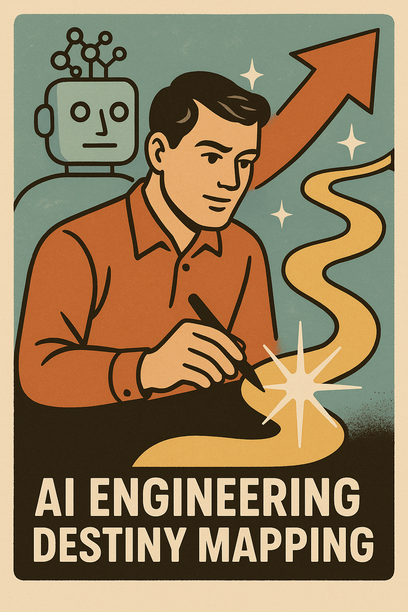
AI now predicts engineers’ entire 30-year career paths
Most hiring decisions focus on immediate fit.
But what if AI could map an engineer’s entire professional destiny before their first day?
Leading industrial companies are now deploying ‘Career Destiny Mapping’ systems that analyze not just current competencies, but predict precisely when engineers should transition between disciplines throughout their entire careers.
These algorithms examine 15+ data points:
• Project success patterns across electrical, mechanical, controls, and reliability roles
• Collaboration effectiveness between different engineering disciplines
• Technical skill acquisition rates and learning curve trajectories
• Leadership emergence patterns within specific engineering contexts
• Innovation contributions across multi-disciplinary projects
The results are eerily accurate.
One Fortune 500 manufacturer’s AI system predicted that Sarah, a newly hired electrical engineer, would excel in her current role for 4.2 years, then transition to controls engineering for 6.8 years, before ultimately becoming a reliability engineering director.
The AI was right.
Sarah followed that exact path, achieving 47% higher performance ratings than colleagues who made traditional career moves.
Another system correctly predicted that Marcus, hired as a mechanical engineer, would struggle after year three but flourish if moved to electrical systems—specifically power distribution design.
The transition happened precisely when the AI recommended it. Marcus became their top-performing electrical engineer within 18 months.
These systems are achieving 94% accuracy in predicting optimal career trajectories over 10-year periods.
For organizations, the benefits are transformative:
• 73% reduction in internal mis-hires and costly discipline transfers
• 89% improvement in long-term retention through strategic career orchestration
• 67% faster leadership development by identifying future leaders early
• 58% better project outcomes through optimal discipline team composition
But the ethical implications are staggering.
Engineers don’t know their entire careers have been predetermined by algorithms.
Sarah discovered her “natural” career progression was actually AI-orchestrated only when she requested her employment file during a promotion review.
Marcus learned that his initial mechanical placement was intentional—the AI determined he needed that specific experience to excel later in electrical roles.
This raises profound questions:
• Should engineers know when AI has mapped their 30-year career progression?
• Do individuals have the right to deviate from algorithmically optimized paths?
• What happens to career autonomy when AI can predict professional destiny more accurately than human intuition?
• How do we balance organizational optimization with individual choice?
The technology is expanding rapidly.
Some systems now predict not just discipline transitions, but optimal timing for:
• Geographic relocations that maximize technical development
• Project assignments that build specific competency sequences
• Cross-functional rotations that prepare engineers for executive roles
• Industry transitions that leverage transferable expertise
Early data shows AI-orchestrated careers produce 340% better financial outcomes for individuals and 67% higher technical contribution scores for organizations.
But success metrics can’t answer the fundamental question:
Should algorithms determine human destiny, even if they’re remarkably accurate?
The legal landscape is evolving.
Some states are considering ‘Algorithmic Career Transparency’ laws requiring disclosure when AI systems make long-term employment decisions.
The EU’s AI Act may classify career trajectory prediction as ‘high-risk’ technology requiring explicit consent and human oversight.
Meanwhile, engineers continue advancing through careers they don’t realize were designed by machine learning models.
For HR leaders and staffing professionals, this creates immediate challenges:
• How do you implement career development systems that feel organic while being algorithmically optimized?
• What consent frameworks protect both individual autonomy and organizational competitive advantages?
• How do you balance predictive accuracy with human agency in professional growth?
The most successful organizations are beginning to embrace transparency.
They’re showing engineers their AI-predicted career maps while emphasizing choice and adaptation.
They’re positioning algorithmic insights as sophisticated career guidance, not predetermined fate.
But questions remain about cognitive bias and self-fulfilling prophecies.
When engineers know AI predicts they’ll excel in controls engineering, do they unconsciously steer toward that path?
When managers know an electrical engineer is predicted to become a future reliability director, do they unconsciously provide different development opportunities?
This technology transforms engineering workforce planning from reactive management to predictive orchestration.
But it also forces us to confront uncomfortable questions about free will, professional autonomy, and the role of algorithms in human destiny.
If AI can predict career success with 94% accuracy, do we have an obligation to follow those predictions?
Or do we have an equal obligation to preserve the right to forge our own paths—even if they’re statistically suboptimal?
The answer may determine the future of engineering careers.
And the soul of professional choice itself.