
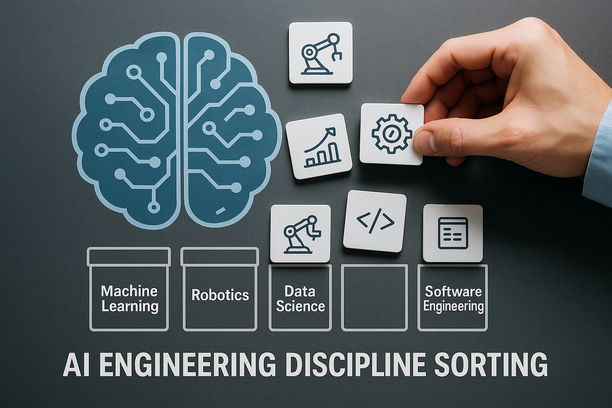
AI now decides which engineering discipline suits you best
Major employers are quietly deploying AI systems that can determine whether you’re destined for electrical, mechanical, controls, or reliability engineering—before you even know it yourself.
The technology analyzes communication patterns, problem-solving sequences, and cognitive processing styles during technical interviews to predict discipline-specific performance with 89% accuracy.
Here’s how it works:
Candidates who break complex problems into sequential, logical steps get flagged for controls and automation roles. Those who visualize physical relationships and stress patterns are steered toward mechanical engineering. Professionals who think in systems and power flows are directed to electrical positions.
The AI doesn’t just assess technical knowledge—it maps cognitive fingerprints to engineering disciplines.
One Fortune 500 manufacturer reports that AI discipline matching reduced engineering mis-hires by 73% while improving project completion rates by 45%. Their AI correctly identified that a candidate’s verbal reasoning patterns indicated controls engineering aptitude, even though the person applied for a mechanical role.
The candidate excelled in automation systems and became their lead PLC programmer.
But here’s the controversial part:
Most candidates never know AI has analyzed their cognitive patterns and predetermined their technical trajectory.
The system operates invisibly during standard technical assessments. Candidates think they’re demonstrating general engineering competency, but algorithms are actually mapping their minds to specific disciplines.
Some companies use this intelligence to guide interview conversations, subtly steering promising candidates toward disciplines where AI predicts they’ll succeed. Others use it for post-hire development planning, creating discipline-specific growth paths based on cognitive analysis.
The ethical questions are staggering.
Should candidates know when AI has analyzed their thought processes? Do people have the right to choose their engineering path, even if data suggests they’d perform better elsewhere? Are we creating a system where algorithms determine technical careers instead of human aspiration?
The accuracy is undeniable, but so are the implications.
Consider the warehouse automation engineer who dreams of transitioning to data center electrical work. Traditional hiring might give them a chance to prove transferable skills. But AI discipline sorting could flag their cognitive patterns as mechanical-oriented and automatically screen them out of electrical roles.
Or the reliability engineer whose problem-solving style aligns with controls automation, but who values the investigative nature of failure analysis. AI might push them toward PLC programming when their passion lies in root cause investigation.
Even more concerning: What happens when AI discipline sorting intersects with unconscious bias?
If the training data reflects historical patterns where certain demographics gravitated toward specific disciplines, AI could perpetuate those limitations at scale. The system might consistently steer women toward certain engineering paths while directing men toward others, based on pattern recognition rather than individual capability.
The technology is already deployed across manufacturing plants, data centers, and infrastructure projects.
Some organizations justify it as optimization—matching human cognitive strengths to technical requirements for better outcomes. Others see it as evolution—using data to guide career decisions instead of relying on trial and error.
But critics argue it reduces human potential to algorithmic predictions.
The most advanced systems now combine discipline prediction with performance forecasting. They don’t just identify which engineering path suits someone—they predict how successful they’ll be in that discipline over 5-10 years.
Imagine being told by an algorithm that while you could succeed as a mechanical engineer, you’d be extraordinary as a controls engineer. Do you follow the data or your intuition?
For staffing agencies and employers, the implications are massive.
AI discipline sorting could revolutionize technical hiring by eliminating guesswork and reducing costly mis-placements. It could help candidates discover engineering strengths they never knew they possessed.
But it could also create a world where career paths are predetermined by cognitive analysis rather than human choice.
The question isn’t whether this technology works—the data proves it does.
The question is whether we want algorithms deciding engineering destinies.
As this technology expands, candidates should demand transparency about cognitive assessment and discipline prediction. Employers should establish ethical frameworks for using AI career guidance.
Because the line between optimization and predetermination is thinner than we think.
And once AI starts sorting engineering minds, there’s no going back.