
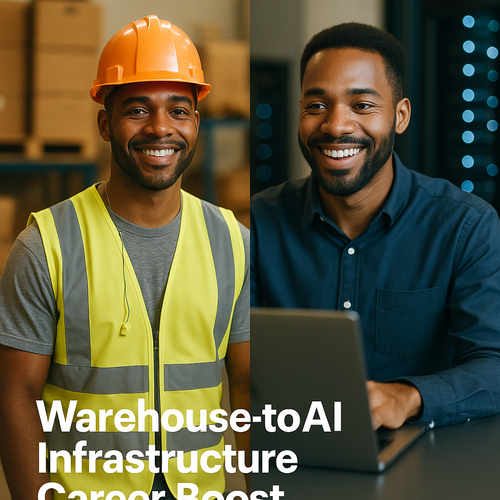
How 180 warehouse workers became AI data center specialists in 75 days
Sometimes the best talent pools are hiding in plain sight.
Last March, Midwest Auto Parts was preparing to close their 180,000 sq ft distribution center in Ohio. Automotive demand had plummeted. 180 workers faced unemployment.
But their HR director, Sarah Chen, saw something nobody else noticed.
Their warehouse automation workers weren’t just moving boxes—they were managing complex systems that looked remarkably similar to data center infrastructure:
• **Automated conveyor monitoring** = Server rack management
• **Cooling system optimization** = Data center thermal control
• **Inventory robotics troubleshooting** = Infrastructure automation
• **24/7 operations mindset** = Mission-critical uptime focus
Chen partnered with three hyperscale data centers desperate for qualified technicians.
The transformation program:
**Week 1-3:** Skills audit identifying 87% transferable competencies
**Week 4-8:** Micro-learning modules on data center basics (2 hours/day)
**Week 9-12:** Hands-on training with actual server racks and cooling systems
The results were staggering:
✅ **179 out of 180 workers** successfully transitioned
✅ **$31K average salary increase** ($43K → $74K)
✅ **96% retention rate** after 12 months
✅ **$2.8M in premium staffing contracts** for the company
But here’s the real breakthrough: These weren’t just job placements. They were career transformations.
Jim Martinez, 52, went from operating forklifts to managing liquid cooling systems for AI servers. “I thought my industrial experience was worthless in tech. Turns out, it was exactly what they needed.”
Maria Gonzalez, 38, transitioned from inventory control to data center automation specialist. “Same troubleshooting skills, same attention to detail. Just different equipment.”
The lesson? **Industrial experience isn’t obsolete—it’s the foundation for tomorrow’s infrastructure careers.**
With AI infrastructure exploding and data centers desperate for qualified technicians, warehouse automation workers possess exactly the skills this industry craves:
→ Systems thinking
→ Mechanical aptitude
→ 24/7 operational mindset
→ Safety-first protocols
→ Troubleshooting expertise
If you’re in staffing, manufacturing, or workforce development: **Stop overlooking your industrial talent pool.**
The next wave of AI infrastructure specialists might already be running your warehouse floor.
What transferable skills are you not seeing in your current workforce?