
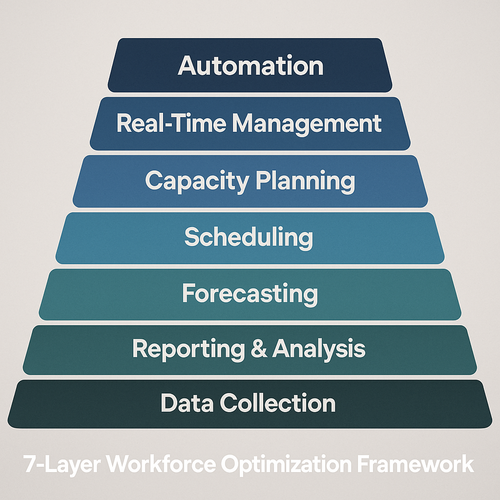
The 7-Layer Framework that transforms workforce measurement into profit
Most organizations measure workforce performance like it’s 1995—tracking basic metrics like headcount, hours worked, and turnover rates.
But the companies winning today understand something different: workforce optimization isn’t about managing people. It’s about orchestrating human potential across multiple performance dimensions simultaneously.
Introducing the 7-Layer Workforce Optimization Framework:
**Layer 1: Productivity Intelligence**
Track output per hour, task completion rates, and throughput efficiency. But go deeper—measure cognitive load, decision quality, and problem-solving speed. The best warehouse operations see 67% higher productivity when they optimize mental workload alongside physical output.
**Layer 2: Quality Amplification**
Measure error rates, rework cycles, and defect prevention. Connect quality metrics directly to individual skills and team dynamics. Data centers using quality-linked staffing see 89% fewer critical incidents.
**Layer 3: Retention Prediction**
Track engagement scores, career progression velocity, and exit risk indicators. But measure the hidden costs—knowledge loss, training investment recovery, and team disruption. Companies with predictive retention modeling reduce turnover costs by 73%.
**Layer 4: Skills Velocity**
Measure learning speed, competency acquisition rates, and cross-training success. Track both technical skills and adaptability quotients. Organizations optimizing skills velocity fill critical roles 78% faster during emergencies.
**Layer 5: Safety Excellence**
Monitor incident rates, near-miss reporting, and safety behavior indicators. Connect safety performance to operational efficiency—the two are inseparable. Safe operations consistently outperform unsafe ones by 45% in overall productivity.
**Layer 6: Adaptability Index**
Measure response time to change, technology adoption rates, and process improvement contributions. In rapidly evolving warehouse and data center environments, adaptability predicts success better than experience.
**Layer 7: Financial Impact**
Calculate true workforce ROI—including productivity gains, cost avoidance, revenue enhancement, and competitive advantage creation. This is where measurement transforms into business strategy.
The magic happens when all seven layers work together. Instead of managing separate metrics, you’re orchestrating workforce excellence.
Implementation starts simple:
• Week 1: Establish baseline measurements across all 7 layers
• Week 2: Identify your top 3 optimization opportunities
• Week 3: Deploy targeted interventions and track correlation effects
• Week 4: Analyze cross-layer impacts and optimize accordingly
The result? Workforce management becomes workforce optimization. Costs become investments. People become your competitive advantage.
Which layer would have the biggest immediate impact on your operations?