
Your engineering hiring process is bleeding talent: and you might not even realize it.
While you're demanding four-year degrees for roles that brilliant self-taught developers could master in months, your competitors are quietly building powerhouse teams by focusing on what actually matters: proven skills over prestigious diplomas.
The numbers don't lie. Companies like IBM, Google, and Tesla have already figured this out, dropping degree requirements for over 50% of their technical positions. Meanwhile, organizations stuck in the "degree-first" mindset are experiencing 40% longer time-to-hire and missing out on the most innovative engineering talent entering the market.
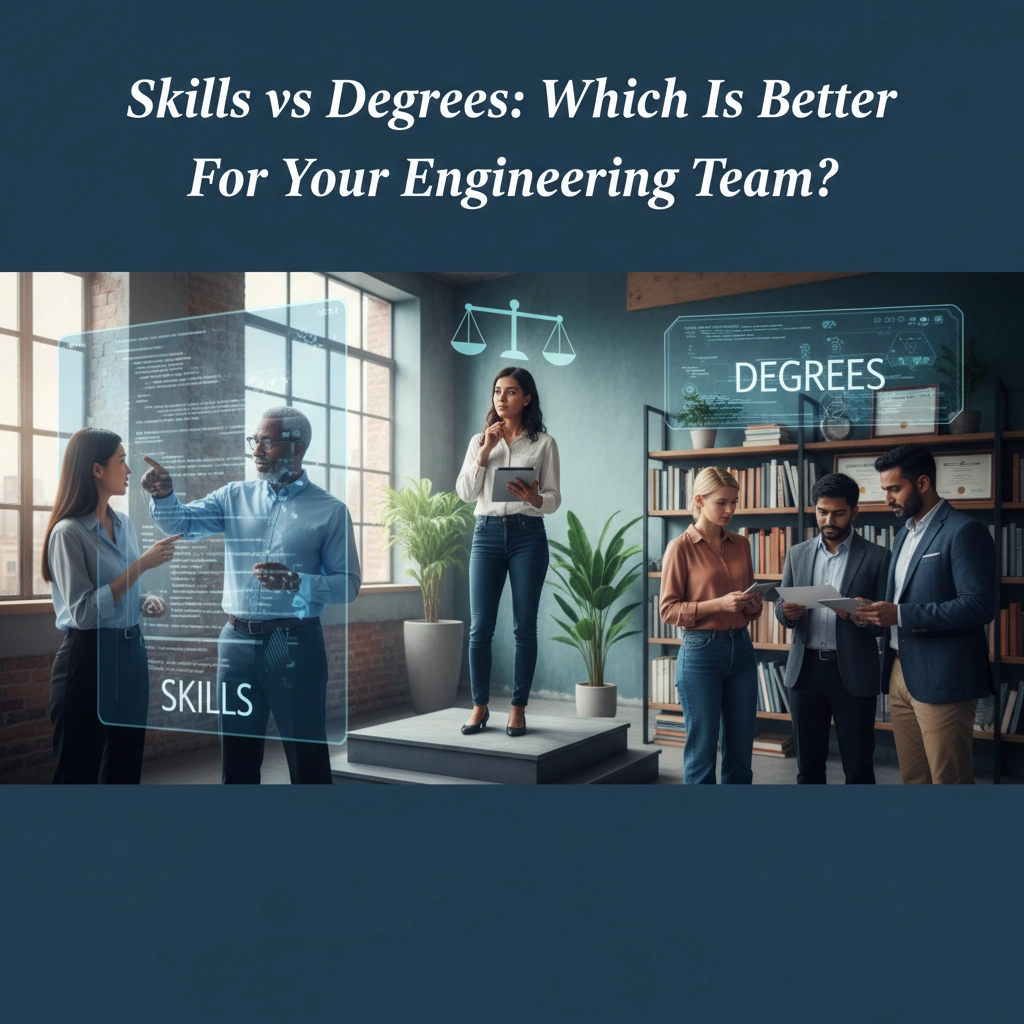
But here's the uncomfortable truth: neither pure skills-based nor pure degree-based hiring will give you the engineering team you need. The real competitive advantage lies in knowing exactly when to prioritize each approach: and most staffing decisions get this wrong.
The Hidden Cost of Degree-Only Hiring
Your current hiring requirements are functioning as an expensive talent filter that's costing your organization far more than just longer recruitment cycles.
The Diversity Crisis: When you mandate four-year engineering degrees, you're automatically excluding brilliant minds who chose alternative paths: bootcamp graduates crushing leetcode problems, military veterans with hands-on systems experience, and career-changers who've built impressive portfolios while working full-time jobs.
The Innovation Bottleneck: Traditional computer science programs often lag 2-3 years behind current industry practices. While universities are still teaching outdated frameworks, self-taught engineers are mastering the latest cloud architectures, AI/ML implementations, and emerging technologies your company actually needs.

The Speed Problem: Degree-based hiring creates artificial scarcity. When you're competing with every other company for the same pool of credentialed candidates, you're guaranteed longer searches, higher salary demands, and more counteroffers. Your time-to-fill stretches from weeks to months.
Consider this: 59% of engineering leaders admit they've passed on exceptional candidates purely because of degree requirements, only to hire less capable graduates who required extensive additional training.
Skills-Based Hiring: The Performance Revolution
The most successful engineering teams are built around one simple principle: demonstrate, don't credential.
Skills-based hiring means evaluating candidates through practical assessments: coding challenges, system design exercises, portfolio reviews, and real problem-solving scenarios that mirror your actual work environment.
The Immediate Advantages
Faster Results: Companies implementing skills-based hiring report 40% reduction in time-to-hire because assessments quickly separate capable engineers from resume padding. Instead of waiting months to find the "perfect" candidate with the right degree, you're identifying talent within weeks.
Better Performance Prediction: A well-designed coding assessment or architectural challenge reveals far more about an engineer's capabilities than any transcript. You're seeing exactly how they think, code, and solve problems under pressure.
Cost Efficiency: Shorter hiring cycles mean lower recruitment costs, reduced manager time spent interviewing, and faster project delivery. The financial impact compounds quickly across multiple hires.
The Talent Pool Explosion
When you remove degree barriers, your candidate pool doesn't just grow: it transforms. You gain access to:
- Bootcamp graduates with intensive, practical training in current technologies
- Self-taught developers with demonstrated passion and continuous learning habits
- Career changers bringing valuable cross-industry perspectives and problem-solving approaches
- International talent with exceptional skills but non-traditional educational backgrounds

Real-World Success Stories
Major employers are already capitalizing on this shift:
- IBM eliminated degree requirements for over 40% of their technical roles and reports higher job satisfaction scores among skills-hired employees
- Deloitte found that skills-based hires in their technology consulting division outperformed degree-required hires in client satisfaction ratings
- Accenture reduced their engineering hiring timeline by 35% after implementing practical assessment protocols
When Degrees Still Matter: The Strategic Exceptions
Before you eliminate all degree requirements, recognize that certain engineering contexts genuinely benefit from formal education foundations.
Regulated Industries and Complex Systems
Civil and Structural Engineering: Professional Engineer (PE) licensure requirements make degrees non-negotiable. When you're designing bridges, buildings, or infrastructure where public safety is paramount, the systematic education and ethical training provided by accredited programs remains essential.
Aerospace and Defense: Security clearance requirements, regulatory compliance, and the theoretical foundations needed for complex systems design often necessitate formal engineering degrees.
Research and Development Roles: Positions involving cutting-edge research, patent development, or fundamental algorithm design benefit from the deep mathematical and theoretical foundations that structured degree programs provide.
Senior Leadership and Architecture Positions
Engineering managers and senior architects often need the broad foundational knowledge that degrees provide: not just coding skills, but understanding of software engineering principles, system scalability, project management, and cross-disciplinary communication.
The key insight: match your requirements to actual role demands, not organizational tradition.
The Hybrid Framework: Your Competitive Advantage
The highest-performing engineering teams use a strategic hybrid approach that optimizes for both immediate capability and long-term potential.

The Role-Based Assessment Matrix
Junior/Entry-Level Positions: Prioritize skills demonstrations through practical projects, coding challenges, and portfolio reviews. Degrees become optional if candidates can prove competency through assessment.
Mid-Level Engineers: Focus on demonstrated expertise through previous project success, system design capabilities, and technical leadership examples. Degree relevance decreases as experience increases.
Senior Technical Roles: Evaluate architectural thinking, mentoring capabilities, and strategic technical decision-making. A combination of skills assessment and educational foundation becomes optimal.
Specialized Engineering Disciplines: Maintain degree requirements where regulatory, safety, or deep theoretical knowledge is essential, while still incorporating practical assessments.
Implementation Timeline
Phase 1 (Weeks 1-2): Audit your current job descriptions and identify roles where degree requirements aren't actually necessary for job performance.
Phase 2 (Weeks 3-4): Develop practical assessment protocols: coding challenges, design exercises, or portfolio evaluation frameworks specific to each role type.
Phase 3 (Weeks 5-8): Launch pilot programs for selected positions, tracking metrics like time-to-hire, candidate quality scores, and early performance indicators.
Phase 4 (Ongoing): Refine your approach based on results, expanding successful practices while maintaining degree requirements where they add genuine value.
Measuring Success
Track these key performance indicators:
✓ Time-to-fill reduction of 25-40% for skills-based roles
✓ Candidate pool expansion of 50-75% when degree barriers are removed
✓ Hiring cost per position decrease of 15-30% due to shorter cycles
✓ 90-day performance scores showing comparable or better results vs. degree-required hires
✓ Retention rates maintaining or improving compared to traditional hiring methods
Building Your Skills-First Engineering Team
The engineering talent landscape has fundamentally shifted. The most innovative developers, the most creative problem-solvers, and the most adaptable technical minds aren't necessarily coming through traditional four-year degree programs anymore.
Your hiring strategy needs to evolve accordingly. This doesn't mean abandoning standards: it means focusing on standards that actually predict job success.
Companies that master this balance will build more diverse, more capable, and more innovative engineering teams. Those that don't will keep competing for an increasingly narrow pool of overpriced, potentially outdated talent.
The question isn't whether to choose skills or degrees: it's whether your organization has the strategic sophistication to deploy each approach where it creates the most value.
How many exceptional engineers have you already missed because your requirements focused on where they studied instead of what they can build?