
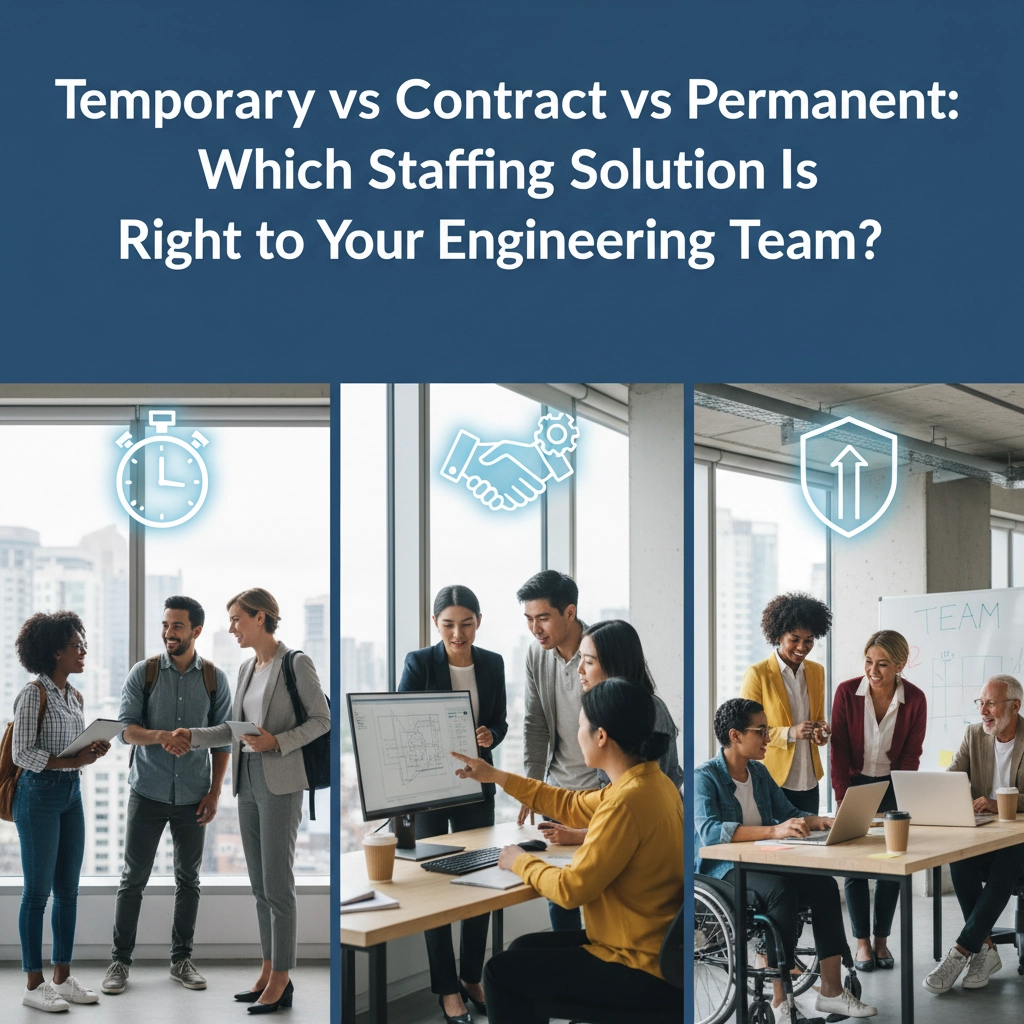
Engineering teams face a complex staffing puzzle in 2025. With project timelines getting tighter and technical requirements becoming more specialized, choosing the right engineering staffing solutions can make or break your next big initiative. Should you go temporary for speed? Contract for expertise? Or permanent for long-term stability?
The answer isn't one-size-fits-all. Each approach offers distinct advantages that align with different project needs, budgets, and growth strategies. Let's break down the real differences and help you build a staffing strategy that actually works.
Temporary Staffing: Speed When You Need It Most
Temporary staffing solutions are your go-to when time is everything. Think of them as your engineering emergency response team: ready to deploy fast and tackle immediate gaps without long-term commitments.
The Speed Advantage
Temporary staffing shines when you need engineers yesterday. Specialized agencies maintain pre-screened talent pools ready to start within days, not weeks. This speed becomes critical during facility startups, production surges, or when key team members are unexpectedly out on leave.
Cost Control That Makes Sense
With temporary staff, you're paying premium rates only while you need the expertise. No long-term salary commitments, no benefits packages, no insurance headaches. For short-term projects or seasonal peaks, this approach keeps your budget lean and flexible.
The Try-Before-You-Buy Factor
Temporary assignments let you assess both technical skills and cultural fit without committing to a permanent hire. If someone excels during a temp assignment, you can always extend a permanent offer. If they don't mesh with your team dynamics, the assignment ends naturally.
When Temporary Works Best
- Sudden demand spikes: Production surges, facility commissioning, or urgent project deadlines
- Coverage gaps: Vacation coverage, medical leave, or unexpected departures
- Budget constraints: When you need expertise but can't justify permanent headcount
- Simple, defined tasks: Projects with clear scope and limited technical complexity
The Reality Check
Temporary staff typically handle more generalized work rather than highly specialized engineering challenges. Their short tenure means limited investment in your specific processes and company culture. For complex, long-term projects requiring deep institutional knowledge, temporary solutions might fall short.

Contract Staffing: Specialized Expertise for Focused Projects
Contract staffing services bridge the gap between flexibility and deep expertise. When your project demands specific technical skills that your current team doesn't possess, contract professionals bring exactly what you need.
Access to Niche Specialists
Contract staffing opens doors to highly specialized talent that would be impossible to justify hiring permanently. Need an automation specialist for a six-month robotics integration? A process engineer with experience in your specific material handling requirements? Contract professionals bring this focused expertise without the long-term commitment.
Project-Focused Integration
Unlike temporary staff who might handle basic tasks, contract engineers typically integrate more deeply into your projects. They understand the scope, timeline, and deliverables. Assignments often span months or even years, giving them time to meaningfully contribute to complex initiatives.
Premium Expertise, Premium Cost
Contract professionals command higher hourly rates than temporary staff, reflecting their specialized skills and deeper project involvement. However, for projects requiring specific expertise, this premium often pays for itself through faster problem-solving and higher-quality outcomes.
Strategic Trial Periods
Contract assignments provide an extended evaluation period for potential permanent hires. You get to see how they handle real projects, work with your existing team, and adapt to your company culture before making a long-term commitment.
Contract Success Scenarios
- Specialized projects: Automation implementations, process optimization, or new technology integration
- Skills gaps: When your team needs expertise that would take months to develop internally
- Defined timelines: Projects with clear start and end dates, specific deliverables
- Evaluate-to-hire: When you want to assess fit before extending permanent offers
The Trade-offs
Contract professionals may struggle with cultural integration since their focus remains project-specific rather than company-wide. The higher costs can strain budgets if projects extend longer than expected. And like any external resource, there's always transition risk when contracts end.
Permanent Staffing: Building Long-Term Engineering Excellence
Permanent placement recruiting represents your strategic investment in long-term capability. These hires become the backbone of your engineering operations, accumulating institutional knowledge and driving continuous improvement.
Institutional Memory That Pays Dividends
Permanent engineers retain critical context that external resources simply can't match. They remember why certain approaches failed, how systems evolved, and what works best in your specific environment. This institutional memory prevents costly mistakes and accelerates future projects.
Cultural Alignment and Team Stability
Permanent staff absorb your company's engineering philosophy, quality standards, and innovation culture. They become mentors for newer team members and champions of your technical standards. This cultural alignment creates consistency across projects and builds trust within engineering teams.
ROI on Development Investments
Training and upskilling investments in permanent staff multiply in value over time. As these engineers grow with your organization, they become increasingly valuable resources who can tackle more complex challenges and mentor others. Your development dollars stay with your company rather than walking out the door.
Deep Process Integration
Permanent engineers develop intimate familiarity with your systems, processes, and quality requirements. They can shepherd projects through multiple lifecycle stages and provide continuity that external resources can't match.
When Permanent Makes Strategic Sense
- Core capabilities: Roles central to your engineering identity and competitive advantage
- Long-term projects: Multi-year initiatives requiring sustained expertise and continuity
- Mentorship needs: Building internal capability and knowledge transfer
- Process ownership: Quality systems, compliance, and continuous improvement initiatives
- Innovation leadership: R&D roles driving future product development
The Investment Reality
Permanent hires require significant upfront investment in recruitment, onboarding, salary, and benefits. The hiring process takes longer, and mismatches become costly to correct. During market downturns, permanent headcount limits your flexibility to adjust quickly.

The Strategic Comparison: Choosing Your Mix
| Approach | Best For | Time to Deploy | Cost Structure | Expertise Level |
|---|---|---|---|---|
| Temporary | Immediate gaps, surge capacity | Days | Low per-assignment, high if ongoing | General engineering skills |
| Contract | Specialized projects, skills gaps | Days to weeks | High hourly, moderate long-term | Highly specialized technical expertise |
| Permanent | Strategic roles, long-term capability | Weeks to months | High upfront, lowest long-term | Organization-specific mastery |
The AList Advantage: Beyond Traditional Staffing Models
At AList Professionals, we've seen how the best engineering teams combine all three approaches strategically. Our diversity hiring initiatives and veteran recruitment pipelines give you access to talented engineers who bring unique perspectives and proven problem-solving abilities.
Our partner approach means we take time to understand your specific technical requirements, company culture, and project timelines. Whether you need a temporary manufacturing engineer to cover a production surge, a contract automation specialist for a robotics project, or a permanent process engineer to lead continuous improvement initiatives, we source from our extensive network of pre-vetted engineering professionals.
What sets us apart is our experience with both large-scale projects and niche technical roles. We understand that a controls engineer for pharmaceutical manufacturing has different requirements than one for automotive assembly. Our screening process evaluates not just technical skills, but also industry-specific experience and cultural fit.
Building Your Hybrid Strategy
The most successful engineering teams we work with adopt a "core-flex" model:
Core Team (Permanent): Strategic roles like engineering managers, senior process engineers, and quality leads who drive long-term innovation and maintain institutional knowledge.
Flex Capacity (Contract): Specialized expertise for defined projects: automation engineers for equipment upgrades, materials engineers for new product development, or compliance specialists for regulatory initiatives.
Surge Support (Temporary): Additional bandwidth during peak periods: commissioning support during facility startups, additional design engineers during crunch periods, or coverage during planned absences.
Making the Right Choice for Your Team
Ask yourself three key questions:
How volatile is your demand? If you face frequent spikes and valleys, temporary and contract solutions provide the flexibility permanent staff can't match.
How specialized are your needs? For highly technical, project-specific requirements, contract professionals often provide the best value. For ongoing, strategic work, permanent hires build lasting capability.
What's your growth trajectory? Rapidly scaling teams might start with contract professionals to handle immediate needs while building permanent capability for the long term.

The Bottom Line
There's no single "right" answer to engineering staffing: the best solution depends on your specific situation, timeline, and budget. Temporary solutions provide speed and flexibility. Contract professionals bring specialized expertise. Permanent hires build long-term capability and institutional knowledge.
The winning strategy often combines all three approaches strategically. Start by identifying your core engineering competencies that require permanent investment, then use contract and temporary solutions to fill gaps, handle surges, and access specialized skills.
Ready to build a staffing strategy that actually works for your engineering team? The right mix of permanent, contract, and temporary solutions can transform how quickly you deliver projects and how effectively you tackle technical challenges.