
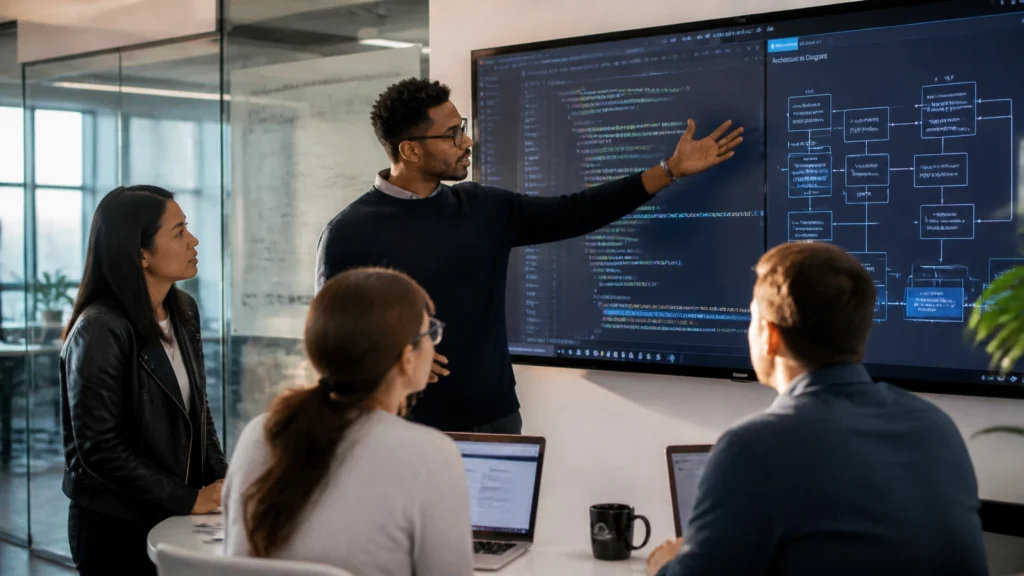
For over a decade, the "whiteboard interview" was the rite of passage for every aspiring software engineer. Candidates would spend months grinding LeetCode problems, memorizing how to invert binary trees or find the shortest path in a weighted graph, all to prove their worth during a high-pressure 45-minute window.
But as we hit the midpoint of 2026, the landscape has shifted fundamentally. With AI agents like GitHub Copilot, Cursor, and ChatGPT now handling 30–40% of boilerplate code, the ability to memorize a sorting algorithm is no longer the hallmark of a "top-tier" engineer.
At AList Professionals, we’ve seen this transition firsthand. As a specialized staffing agency connecting businesses with high-level technical talent, we’ve noticed that the most successful hires today aren't the ones who can code the fastest: they’re the ones who can think the best.
So, is the traditional coding interview dead? Not quite. But its weight has plummeted, and the way we spot "real" talent has undergone a massive, AI-driven transformation.
The AI Elephant in the Interview Room
In 2026, if you ask a candidate to "write a function that checks for a palindrome" during a screen sharing session, you aren't testing their logic; you're testing how quickly they can prompt an AI.
Generative AI has commoditized the "how" of coding. Because of this, the signal-to-noise ratio in traditional interviews has plummeted. When every candidate can produce syntactically perfect code in seconds, how do you differentiate between a senior architect and someone who’s just good at using a LLM?
The answer lies in Outcome-Based Staffing. We are moving away from measuring inputs (lines written, algorithms memorized) and toward measuring outcomes (system reliability, architecture, and problem decomposition).

3 Shifts in How We Evaluate Engineering Talent Today
To find the talent that actually moves the needle in 2026, the interview process has evolved into these three key areas:
1. From "Coding" to "Orchestration"
In the modern stack, an engineer is less of a solo musician and more of a conductor. They must orchestrate AI agents, third-party APIs, and cloud infrastructure.
- The New Test: Instead of writing from scratch, we see more "Code Review" interviews. Candidates are given AI-generated code with subtle logic flaws or security vulnerabilities and asked to find them. This tests their validation skills: arguably the most critical engineering skill of this era.
2. The Rise of "Skills-First" and Veteran Talent
One of the biggest trends we've championed at AList is skills-first hiring. We’ve found that military veterans, for example, often bring a level of discipline, system-level thinking, and grit that outshines traditional candidates.
- Why it works: Veterans are trained in mission-critical environments where they must adapt to new technologies on the fly. In an AI world where the tools change every six months, that adaptability is more valuable than a four-year-old degree in a specific framework.
3. Reasoning and Trade-off Analysis
Recent data shows that for senior roles, the "Reasoning" score in technical interviews now accounts for nearly 30% of the total evaluation weight, up from just 15% a few years ago.
- The Modern Interview: A candidate might be asked to design a system for a high-traffic e-commerce platform. The interviewer isn't looking for a perfect diagram; they are looking for the candidate to explain why they chose a specific database and what the latency trade-offs are.

The AList Approach: More Than Just a Transaction
Traditional staffing agencies often act as a resume mill: throwing as many "qualified-on-paper" candidates at a client as possible. At AList Professionals, we utilize a collaborative "Partner Process."
We don't just look for keywords like "Java" or "Python." We look for:
- AI Fluency: Does the candidate know how to use AI to 10x their productivity without sacrificing code quality?
- Diversity & Inclusion: As a minority-owned firm, we know that diverse teams are more innovative. We specialize in sourcing talent from underrepresented backgrounds who bring unique problem-solving perspectives to technical roles.
- Mission Alignment: Especially in Engineering and IT, a "hired gun" mentality can lead to high churn. We focus on finding talent that aligns with your company’s long-term outcomes.
Spotting the "Quiet" Talent
Sometimes the best engineers are the ones who fail the traditional LeetCode grind. They might be transitioning from other technical sectors or have non-traditional backgrounds.
In 2026, spotting real talent requires looking at the human elements that AI cannot replicate:
- Empathy for the User: Understanding why a feature is being built.
- Collaboration: How well they pair-program (with humans and AI).
- Communication: Can they explain a complex architectural decision to a non-technical stakeholder?

Conclusion: The Future is Collaborative
The traditional coding interview isn't dead: it's just been demoted. It is now a "hygiene check" rather than the main event. In the age of AI, the true value of an engineer lies in their judgment, their ability to design robust systems, and their capacity to lead teams through complexity.
If your organization is still hiring like it’s 2019, you’re likely missing out on the best talent the 2026 market has to offer.
Ready to modernize your technical recruitment? Whether you need emergency AI infrastructure talent or a long-term engineering partner, AList Professionals is here to help. We combine 30 years of experience with a forward-looking, diversity-focused approach to ensure you’re not just filling seats, but building a future-proof team.
Contact AList Professionals Today to start your collaborative hiring journey.
