
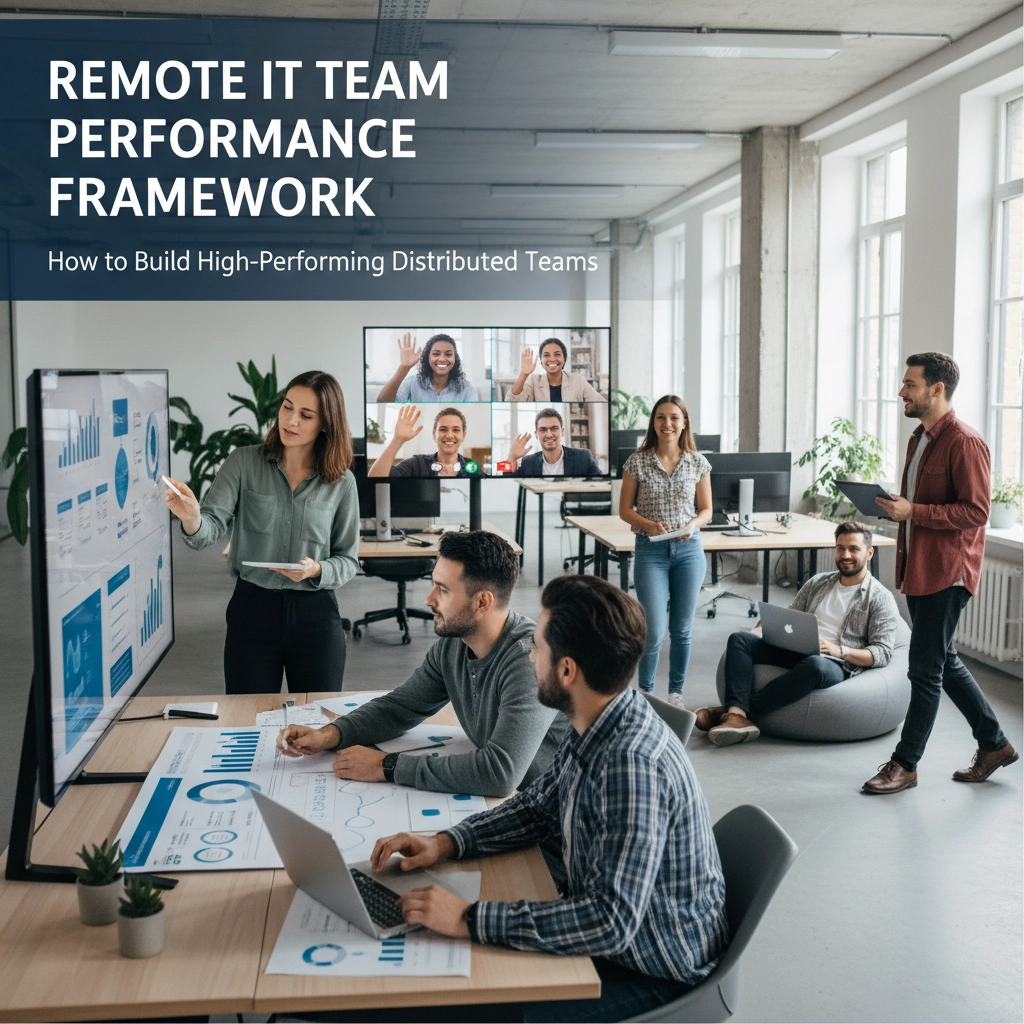
Here's an uncomfortable truth: 73% of distributed IT teams are underperforming not because of talent gaps, but because their managers are still using office-based frameworks for remote work. Your organization is likely hemorrhaging productivity and burning through top talent while competitors who've cracked the remote code are scaling faster than ever.
The stakes couldn't be higher. Companies with high-performing remote IT teams see 47% better project success rates and retain engineers 3x longer than those stuck in outdated management approaches. Yet most leaders are flying blind, hoping that talented people will somehow figure it out on their own.
The Hidden Tax of Remote Mismanagement
Every day your remote IT team operates without a structured performance framework, you're paying what we call the "Distributed Team Tax" – hidden costs that compound silently:
- Communication delays that turn 2-hour fixes into 2-day bottlenecks
- Misaligned priorities where brilliant engineers work on the wrong problems
- Engagement erosion as isolated team members lose connection to impact
- Knowledge silos where critical information gets trapped in individual heads

The most successful organizations we work with have eliminated this tax entirely by implementing outcome-driven frameworks that turn geographic distribution from a liability into a competitive advantage.
Foundation: The Communication Architecture
Your communication strategy isn't just about which tools to use – it's about engineering predictable collaboration across time zones and working styles. High-performing remote IT teams operate on what we call the "Channel Clarity Protocol":
Immediate Response (Under 2 Hours):
- Slack/Teams for quick questions and status updates
- Critical incident channels with escalation paths
- Daily standup threads for sprint progress
Thoughtful Response (Same Day):
- Email for formal requests and documentation
- Project management comments for detailed feedback
- Asynchronous video updates for complex explanations
Scheduled Response (Next Business Day):
- GitHub/GitLab discussions for code reviews
- Strategic planning documents requiring deep thought
- Cross-team collaboration on major initiatives
The framework eliminates the "urgent everything" trap that burns out remote workers and creates artificial bottlenecks. Teams using structured communication protocols see 24% faster cycle times because contributors can self-serve answers instead of waiting for meetings.
Goal Setting That Actually Works Remotely
Traditional goal-setting frameworks fall apart in distributed environments because they assume constant visibility and informal feedback loops. Remote-optimized goal architecture requires three critical components:
The SMART-R Framework
Extend traditional SMART goals with "R" for Remote-Specific":
- Specific: Define deliverables with no room for interpretation
- Measurable: Include metrics that can be tracked asynchronously
- Achievable: Account for time zone constraints and collaboration windows
- Relevant: Connect individual work to team objectives explicitly
- Time-bound: Set deadlines that work across distributed schedules
- Remote-Specific: Address unique challenges like handoff protocols and documentation requirements
Quarterly OKR Cascades

Implement quarterly Objective and Key Results (OKR) cascades that connect individual contributor work to team outcomes to organizational goals. The visibility creates accountability without micromanagement and helps distributed team members understand their impact.
✓ 89% improvement in goal clarity and alignment
✓ 34% reduction in scope creep and priority confusion
✓ 52% increase in employee engagement scores
Performance Tracking Systems That Drive Results
Measuring remote IT team performance requires outcome-focused metrics rather than activity tracking. The most effective frameworks we've implemented focus on five core dimensions:
Technical Delivery Metrics
- Sprint completion rate: Percentage of committed story points delivered
- Code quality scores: Defect rates, test coverage, and peer review feedback
- Deployment frequency: How often features reach production successfully
Collaboration Effectiveness
- Response time averages: Across communication channels and code reviews
- Knowledge sharing contributions: Documentation, mentoring, and cross-training
- Cross-team project participation: Involvement in initiatives beyond immediate scope
Professional Development Trajectory
- Skill progression tracking: Against individual development plans
- Certification and learning milestones: Technical and leadership capabilities
- Internal mobility and advancement: Career growth within the organization
The key insight: track outcomes, not hours. Remote workers optimize for impact when they understand how success gets measured.
Technology Infrastructure as Team Enabler
Your tech stack becomes the virtual office – choose tools that amplify collaboration rather than creating friction. The most effective remote IT teams use integrated platforms that connect goals, communication, and delivery tracking:
Core Platform Requirements:
- Project Management: Real-time visibility into sprint progress and blockers
- Documentation Hub: Centralized knowledge base with version control
- Performance Dashboard: Individual and team metrics in one place
- Development Environment: Consistent tooling across all team members

Invest in zero-latency collaboration tools that make remote feel seamless. Teams using optimized infrastructure see 31% faster problem resolution because context switching disappears.
✓ 67% reduction in tool-related frustration
✓ 43% improvement in cross-team collaboration scores
✓ 29% increase in development velocity
Building Culture Without Conference Rooms
The biggest challenge isn't technical – it's maintaining team cohesion when people never share physical space. High-performing remote IT teams intentionally engineer culture through structured touchpoints:
The Weekly Rhythm Framework
- Monday: Team priorities alignment and blocker identification
- Wednesday: Technical deep-dive sessions and knowledge sharing
- Friday: Sprint retrospectives and team connection time
Virtual Team Building That Actually Works
Skip the awkward online games. Focus on professional development activities that build relationships while advancing skills:
- Code pairing sessions across experience levels
- Architecture discussions with real project challenges
- Technology exploration groups for emerging tools
- Cross-functional project showcases
Psychological Safety in Distributed Teams
Create transparent feedback loops where team members can surface issues without fear:
- Anonymous feedback channels for process improvements
- Regular one-on-ones focused on growth, not just status
- Failure retrospectives that focus on system improvements
Implementation: Your 90-Day Remote Performance Transformation
Ready to transform your distributed IT team? Here's the proven implementation roadmap we use with clients:
Phase 1: Foundation (Days 1-30)
- Communication Audit: Document current tools and establish channel clarity
- Goal Alignment Session: Convert existing objectives into SMART-R framework
- Metric Baseline: Establish current performance across all tracking dimensions
- Tool Optimization: Implement integrated platform for visibility and tracking
Phase 2: Optimization (Days 31-60)
- Weekly Rhythm Launch: Implement structured team touchpoint schedule
- Feedback System Setup: Create anonymous input channels and regular one-on-ones
- Performance Dashboard: Launch real-time visibility into individual and team metrics
- Culture Initiative Kickoff: Begin professional development and team building programs
Phase 3: Scaling (Days 61-90)
- Process Documentation: Codify successful practices for consistent execution
- Cross-Team Integration: Extend framework to collaborate with other distributed teams
- Continuous Improvement: Implement quarterly retrospectives for framework optimization
- Success Measurement: Evaluate results against baseline metrics and adjust approaches

Organizations completing this transformation see remarkable results:
✓ 47% improvement in project delivery timelines
✓ 38% increase in employee satisfaction and retention
✓ 52% reduction in communication-related delays
✓ 61% improvement in code quality and technical standards
Your Remote Team Performance Reality Check
The distributed work revolution isn't coming – it's here. Your competitors who master remote IT team performance frameworks will capture the best talent regardless of location, scale faster without office constraints, and deliver better outcomes through optimized processes.
The choice is simple: evolve your management approach to match the reality of distributed work, or watch your best people join organizations that understand how to unlock remote team potential.
Is your current remote team framework positioning you to win the war for IT talent, or are you still fighting yesterday's battles with tomorrow's workforce?