
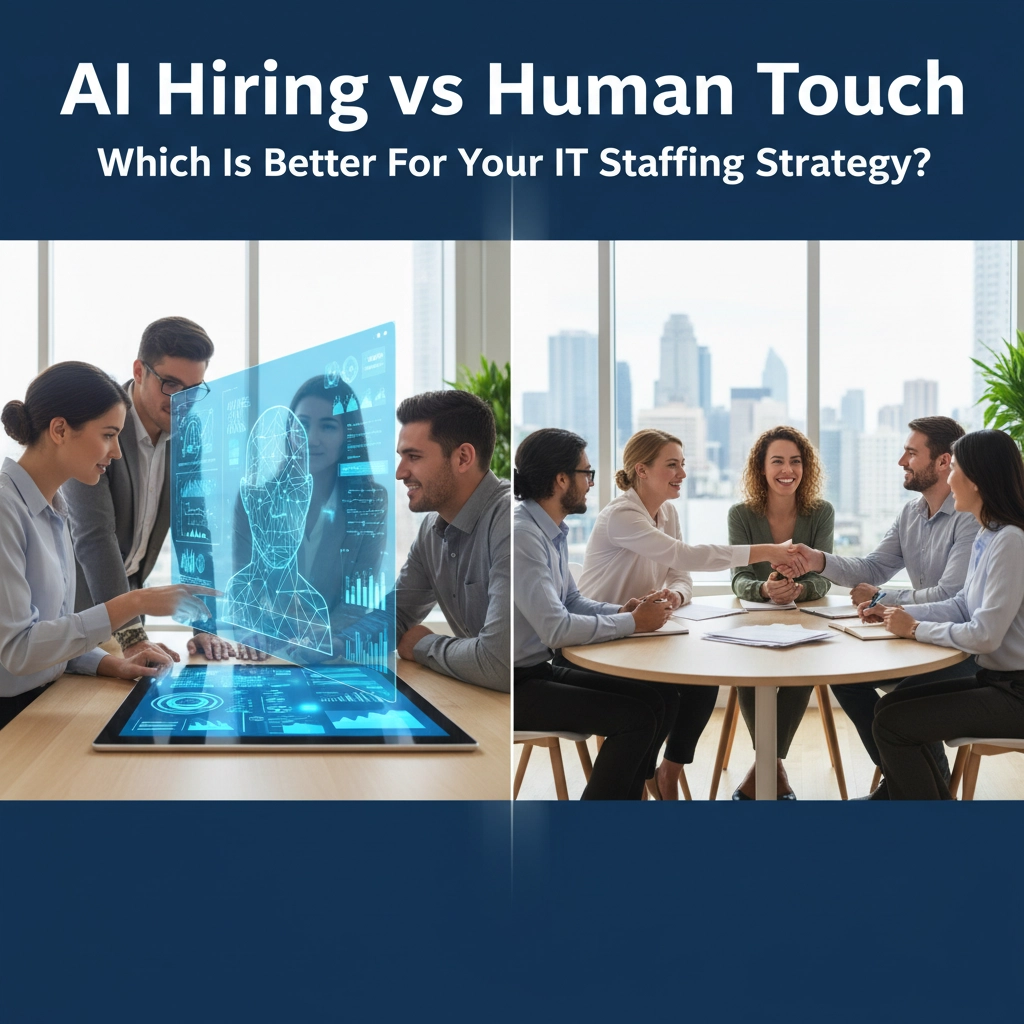
The IT staffing world is having a moment. Half the industry is going all-in on AI recruitment tools, while the other half is doubling down on relationship-driven, human-centered approaches. So who's right?
Here's the thing, this isn't really an either-or situation. The smart money is on understanding when to use each approach (and when to blend them). Let's break down what actually works in today's tech talent landscape.
The AI Advantage: Speed, Scale, and Savings
Where AI Crushes It
AI-powered recruitment isn't just a fancy buzzword, it's delivering real results. We're talking about a 75% reduction in time-to-shortlist compared to manual processes. That means getting qualified candidates in front of hiring managers weeks faster than traditional methods.
The numbers don't lie: AI can process 10x more candidates than human recruiters and works around the clock. No coffee breaks, no vacation days, no geographic limitations. For high-volume IT roles, think developers, QA engineers, or technical support positions, this scalability is a game-changer.

Cost-wise, the math is pretty compelling:
- 20% reduction in cost per hire through automation
- Some analyses show up to 76% cost savings vs. traditional recruiting
- AI systems run about $33k annually compared to $139k for a full-time recruiter
For contract staffing services, this efficiency translates to faster placements and better margins. You can respond to client needs almost instantly instead of spending days sorting through resumes manually.
The Technical Sweet Spot
Here's where AI really shines in IT staffing: technical skill matching. AI systems excel at parsing through complex technical requirements and matching them against candidate profiles. They can instantly identify whether someone has the right Python frameworks, cloud certifications, or database experience: stuff that might take human recruiters hours to verify.
The consistency factor is huge too. AI applies the same evaluation criteria to every candidate, which helps with diversity recruitment services by removing some of the unconscious bias that can creep into human decision-making.
But AI Has Blind Spots
Let's be real: AI isn't perfect. It struggles with the nuanced stuff that makes IT teams actually work well together. Cultural fit? Soft skills? The ability to explain complex technical concepts to non-technical stakeholders? These are areas where AI falls flat.
There's also the implementation reality. Getting AI systems up and running requires serious upfront investment and ongoing maintenance. If you're a smaller IT staffing agency without the resources to properly implement and maintain these tools, the ROI might not be there yet.
The Human Touch: Relationships, Culture, and Context
What Humans Do Best
Human recruiters bring something AI can't replicate: genuine relationship-building and cultural assessment. They can pick up on subtle cues during conversations, understand career motivations beyond salary requirements, and build long-term networks of passive candidates.

For senior IT roles or specialized positions, this human element becomes critical. A seasoned recruiter can identify that perfect DevOps engineer who isn't actively looking but might be interested in the right opportunity. They can also navigate the complex negotiations and relationship dynamics that come with executive-level placements.
The relationship advantage extends to both sides:
- Candidates get personalized guidance and career counseling
- Clients get strategic insights about market conditions and salary expectations
- Long-term partnerships develop that benefit everyone
The Performance Question
Here's an interesting data point: some studies suggest staff hired through AI-led interviews generated 12% more job offers and stayed 17% longer than those hired by human recruiters. But before we declare AI the winner, there's more to this story.
Human recruiters excel in scenarios where trust and discretion matter. For sensitive roles or competitive hiring situations, the personal touch often wins. They can also identify red flags that AI might miss: like attitude issues or communication problems that only surface in real conversation.
Human Limitations in Today's Market
The reality is that traditional recruiting doesn't scale well. Manual processes consume 30-40 recruiter hours per hire and operate only during business hours. When you're competing for tech talent sourcing in a global market, those limitations can cost you the best candidates.
Geographic expansion is another challenge. Growing your human recruiting team across multiple markets requires significant investment in hiring and overhead. Meanwhile, AI systems can handle multilingual candidates and global time zones without additional costs.
The Smart Play: Blending Both Approaches
Most successful IT staffing agencies aren't choosing sides: they're building hybrid systems that leverage the strengths of both approaches.

The Hybrid Model That Works
Stage 1: AI-Powered Screening
- Automated resume parsing and initial skill matching
- 24/7 candidate engagement and scheduling
- High-volume screening for technical requirements
- Bias-reduction through consistent evaluation criteria
Stage 2: Human Assessment
- Cultural fit evaluation and soft skills assessment
- Complex technical discussions and problem-solving scenarios
- Relationship building and career counseling
- Final negotiations and offer management
This approach captures AI's efficiency gains while preserving human judgment on the decisions that matter most. You get the speed and scale benefits without sacrificing quality or candidate experience.
Real-World Applications
For contract staffing services, this hybrid approach is particularly powerful. AI handles the heavy lifting of matching available contractors with project requirements, while human recruiters manage client relationships and handle complex placement negotiations.
The diversity benefits are significant too. AI reduces initial screening bias, while human recruiters can focus on building inclusive candidate pipelines and ensuring fair evaluation processes throughout the hiring funnel.
Making the Right Choice for Your Strategy
Go AI-Heavy When:
- You're filling high-volume, standardized IT roles
- Speed is critical (need placements in 10-30 days)
- You have the budget and technical capabilities for implementation
- You're scaling rapidly across multiple markets
- You need 24/7 candidate engagement for global talent pools
Prioritize Human Touch When:
- You're placing specialized or executive IT roles
- Cultural fit is paramount to client success
- Your hiring volume is relatively low
- Budget constraints limit AI implementation options
- Clients expect highly personalized service
Build a Hybrid System When:
- You have the resources to implement both approaches
- You're handling diverse client needs across multiple industries
- You want to maximize both efficiency and quality
- Long-term competitive advantage is the goal

The Bottom Line for IT Staffing Success
The future isn't about choosing between AI and human recruiters: it's about orchestrating them effectively. The most successful IT staffing agencies are using AI to eliminate grunt work and amplify human capabilities.
Smart implementation means using AI for what it does best: processing large volumes of data, maintaining consistency, and operating at scale. Reserve human expertise for relationship building, complex decision-making, and the strategic conversations that drive long-term success.
The companies winning in today's market aren't just faster or cheaper: they're providing better candidate and client experiences by combining technological efficiency with human insight. That's where the real competitive advantage lies.
Whether you're just starting to explore AI tools or looking to optimize your existing hybrid approach, the key is understanding your specific market dynamics and client needs. The right blend of AI and human touch will depend on your unique situation, but one thing is clear: the future belongs to agencies that master both.