
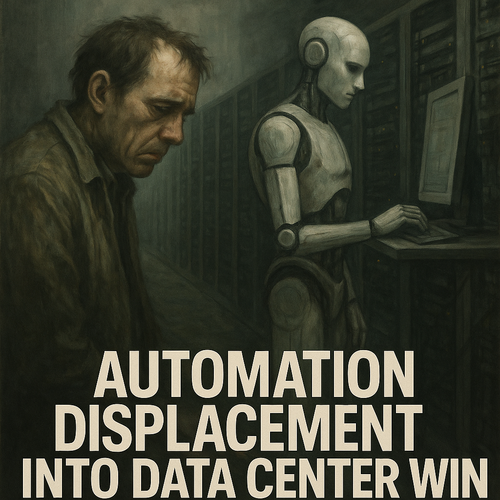
How warehouse automation created data center careers (not unemployment)
Automation doesn’t have to mean unemployment. Here’s proof.
A 340-employee warehouse operation in Ohio was facing the inevitable: robotic picking systems would eliminate 67% of manual positions by Q2 2024. Management projected 230 layoffs.
But instead of accepting displacement, they implemented a radical ‘Skills Bridge’ strategy that transformed potential tragedy into competitive advantage.
Here’s what they discovered:
**The Hidden Connection**
Warehouse automation workers possess 84% directly transferable skills to data center operations:
• HVAC system monitoring and troubleshooting
• 24/7 operations mindset and shift reliability
• Mechanical equipment maintenance and safety protocols
• Automated system monitoring and basic diagnostics
• Working in controlled environments with strict procedures
**The 60-Day Framework**
Week 1-2: Skills assessment and competency mapping
Week 3-6: Targeted micro-learning in data center fundamentals
Week 7-8: Hands-on training with local data center partner
Week 9+: Graduated placement with mentorship support
**The Results**
• 89% successful transition rate (205 of 230 workers)
• Average salary increase: $24,400 (from $38K to $62K)
• 94% retention rate after 12 months
• Zero unemployment insurance claims
• $1.8M in community economic impact
The breakthrough insight? Data centers desperately need workers who understand:
– Critical infrastructure that cannot fail
– Systematic troubleshooting under pressure
– Safety-first operations mentality
– Working with automated monitoring systems
Three local hyperscale operators had been struggling to fill 150+ infrastructure positions for 8+ months. This warehouse provided pre-trained talent with the exact mindset they needed.
**The Strategic Lesson**
Automation displacement is predictable. Data center expansion is exploding. The smart play isn’t fighting automation—it’s building bridges between declining and growing sectors.
For staffing agencies: There’s a massive arbitrage opportunity in workforce transition services. Companies will pay premium rates to avoid layoffs while solving talent shortages simultaneously.
For operations leaders: Your ‘displaced’ workers might be perfect for industries you’ve never considered.
What adjacent industries could absorb your automated workforce? The answer might surprise you.