
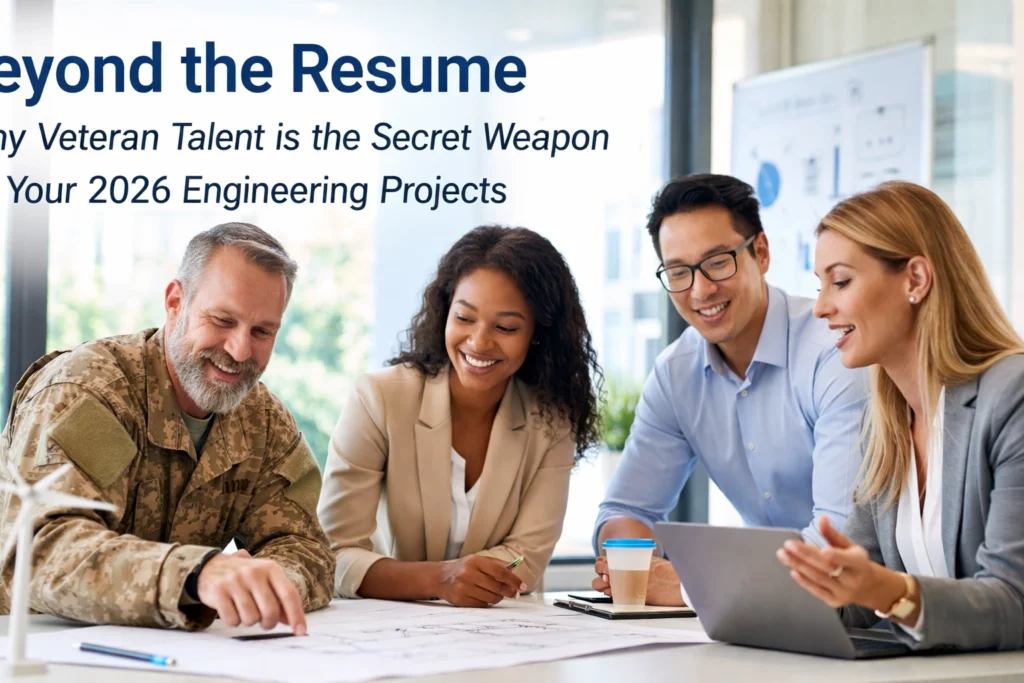
Let's be real for a second. If you're running engineering projects in 2026, you're probably feeling the talent crunch. The technical talent pool keeps shrinking, competition is fierce, and that perfect candidate with the exact certifications you need? They've got five other offers on the table.
But here's the thing, there's a massive talent pool that most companies overlook completely. We're talking about veteran talent, and they might just be the competitive edge your engineering team has been missing.
The Engineering Talent Gap Is Real (And It's Not Getting Better)
You've heard the stats. The engineering skills gap has been widening for years, and 2026 isn't showing signs of slowing down. Companies across infrastructure, tech, manufacturing, and government contracting are all fighting for the same shrinking pool of candidates.
The traditional playbook, posting on job boards, hoping the right resume lands in your inbox, filtering for exact keyword matches, just doesn't cut it anymore. If you're still hiring that way, you're probably losing out on some of the most capable, adaptable technical talent available.
The solution? Stop looking at resumes the old way. Start looking at what people can actually do.

What Veterans Actually Bring to Engineering Teams
When we talk about veteran recruitment for tech and engineering roles, we're not asking you to do anyone a favor. This is about recognizing a genuine competitive advantage that most hiring managers miss.
Technical Expertise That Translates
Here's what a lot of people don't realize: military service is essentially an intensive technical training program. Veterans gain advanced skills in complex systems, equipment maintenance, troubleshooting, and technical problem-solving that map directly onto civilian engineering challenges.
We're talking about professionals who've maintained aircraft systems, managed sophisticated communications networks, operated and repaired heavy machinery in extreme conditions, and troubleshot equipment failures when there was no manual to reference. That's not entry-level capability, that's exactly the kind of hands-on technical expertise that engineering teams desperately need.
Leadership That's Been Battle-Tested
Veterans don't just bring technical skills. They bring leadership experience that's been forged in real-world, high-stakes situations. They've navigated barriers, solved problems through unconventional approaches, and led teams when failure wasn't an option.
That translates to engineering project management gold. When deadlines get tight, budgets get squeezed, and stakeholders start panicking, you want someone on your team who's operated under actual pressure, not just corporate deadline pressure.
Problem-Solving From a Different Angle
Military training teaches you to approach problems systematically and creatively at the same time. Veterans often see solutions that others miss because they've been trained to assess situations from multiple angles and adapt quickly when Plan A falls apart.
For engineering projects that require innovative approaches to complex problems, that perspective is invaluable. It's the kind of thing you can't teach in a certification course.

Reliability You Can Count On
Let's talk about something that doesn't show up on a resume but matters enormously: commitment. Veterans generally demonstrate discipline, a strong sense of purpose, and dedication to mission-driven work.
What does that mean for your engineering team? Lower turnover, better project continuity, and a culture of accountability that lifts everyone's performance. When someone's used to showing up and getting the job done regardless of circumstances, that attitude becomes contagious.
The "Translation" Problem (And How to Solve It)
Okay, so if veteran talent is so valuable, why aren't more companies tapping into it?
The honest answer is that most hiring processes are broken when it comes to recognizing transferable skills. Traditional resume screening looks for exact matches: specific job titles, specific software experience, specific industry background. Veterans often don't check those boxes, even when they have all the underlying capabilities to excel.
A military job title like "Aviation Electrician's Mate" doesn't automatically translate to "Electrical Engineer" in an ATS system. But the skills? The troubleshooting ability? The understanding of complex electrical systems? It's all there.
This is where the right engineering staffing solutions partner makes all the difference. You need someone who understands both worlds: who can look at military experience and accurately map it to civilian engineering requirements.
How AList Professionals Approaches Veteran Recruitment
At AList Professionals, veteran recruitment for tech and engineering roles isn't a side project. It's central to how we operate.
As a minority-owned firm, we understand what it means to bring diverse perspectives to the table. We've built our entire approach around recognizing talent that traditional hiring processes overlook: and veterans are a huge part of that.
The Partner Process: It's About Fit, Not Just Skills
Here's where we do things differently. Our Partner Process isn't just about matching keywords on a resume to keywords in a job description. It's about understanding the whole picture: the candidate's capabilities, their working style, their career goals, and the specific culture of your organization.
For veteran candidates, that means we take the time to genuinely understand their military experience and translate it into terms that make sense for your engineering projects. We don't just send you a stack of resumes and hope something sticks.
For your company, it means we're looking at cultural fit alongside technical capability. The goal isn't just to fill a seat: it's to find someone who will thrive on your team and contribute to your projects for the long haul.

Structured Transition Support
Programs like the Department of Defense SkillBridge Program have created pathways for veterans to translate military skills into civilian roles. We work with these programs and understand how to leverage them effectively.
That means veteran candidates often come to you with structured transition experience, accelerating the onboarding process and allowing them to contribute immediately while continuing their professional development.
The Business Case for Diversity and Inclusion in Engineering
Let's zoom out for a second. Veteran hiring isn't just good for individual projects: it's good for your organization's long-term health.
Diversity and inclusion in engineering teams has been shown to drive innovation, improve problem-solving, and boost overall performance. When you bring in people with different backgrounds and perspectives, you get better outcomes. Period.
Veterans represent a form of diversity that's often undervalued in corporate diversity initiatives. Their experiences, their training, their worldview: it all adds to the richness of your team's collective capability.
And here's the practical side: veteran hiring can also support compliance requirements for government contracts and demonstrate your commitment to broader social responsibility goals. It's a win across multiple dimensions.
Making the Shift in 2026
If you're serious about solving your technical talent challenges in 2026, it's time to expand how you think about qualified candidates. The traditional resume-first approach is leaving incredible talent on the table.
Veteran engineers bring advanced technical skills, proven leadership, unique problem-solving perspectives, and rock-solid reliability. They're exactly the kind of candidates who can elevate your engineering projects: if you know how to find them and how to recognize what they offer.
That's where working with a specialized staffing partner matters. At AList Professionals, we've built our entire model around connecting businesses with talent that traditional processes miss. Our Partner Process ensures that veteran candidates aren't just technically qualified: they're the right fit for your team and your projects.
Ready to discover what veteran talent can do for your 2026 engineering initiatives? Let's talk about how we can help you build the team you actually need.