
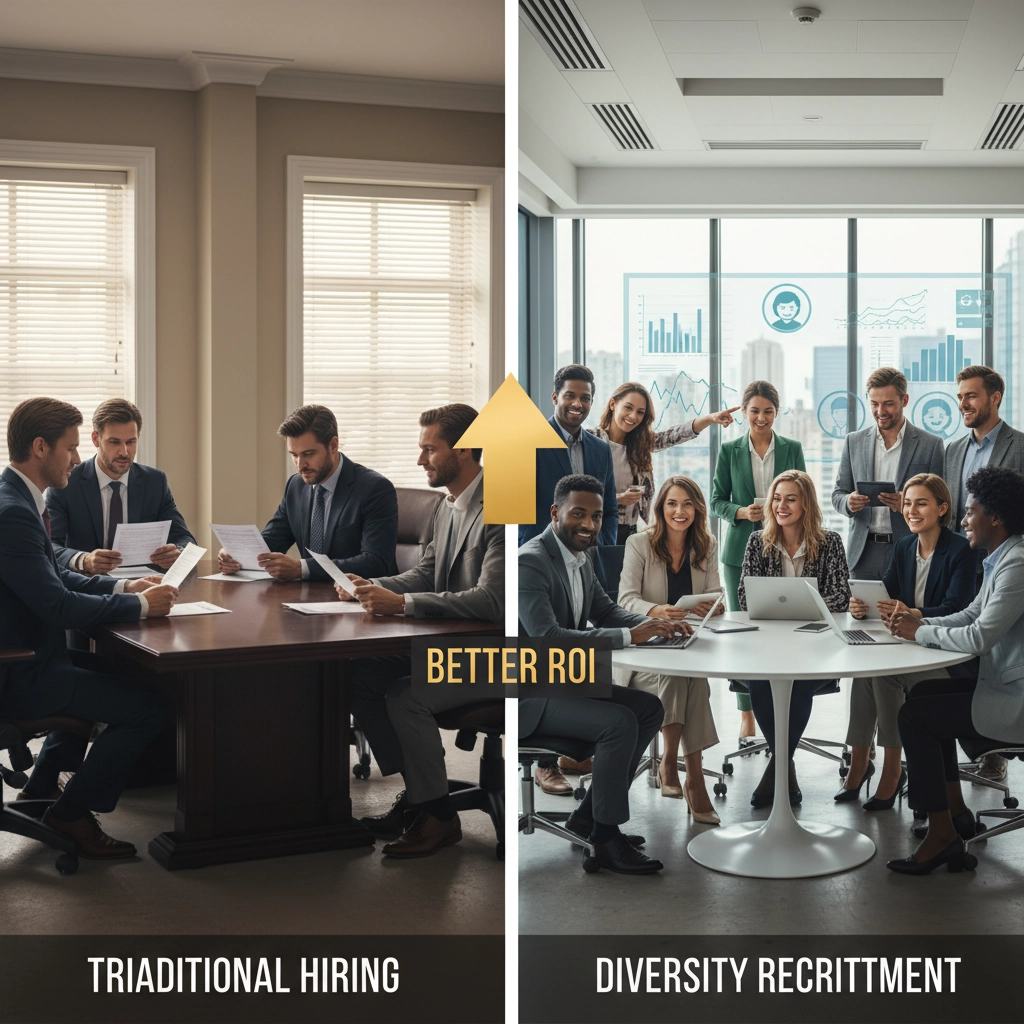
The hiring game has changed dramatically, and the numbers don't lie. Companies that stick to traditional recruitment methods are leaving serious money on the table, while organizations embracing diversity recruitment services are seeing measurable returns that would make any CFO take notice.
But here's the thing – most business leaders still think diversity hiring is just about "doing the right thing." While that's important, the real conversation should be about cold, hard ROI. Let's dive into the data and see which approach actually delivers better business results.
The Financial Reality of Diversity Recruitment
When we talk about diversity recruitment services delivering better ROI, we're not just throwing around feel-good statistics. The financial impact is substantial and measurable.
Companies with gender and ethnic diversity in leadership see 48% higher operating margins and 42% higher return on sales compared to their homogeneous counterparts. That's not a small bump – that's game-changing performance that directly impacts your bottom line.
But it gets even better. Organizations prioritizing diversity are 36% more profitable overall, and diverse teams consistently outperform non-diverse teams by 33%. These aren't marginal gains we're talking about; these are the kinds of numbers that separate industry leaders from the pack.

The innovation angle is particularly compelling. Nearly half of the revenue at diverse companies comes from recent innovations, compared to just one-quarter at homogeneous organizations. When you're competing in today's fast-moving markets, that innovation edge can make or break your growth trajectory.
Where Traditional Hiring Falls Short
Traditional hiring methods seem straightforward – post a job, review resumes, interview candidates with the right credentials, and make a hire. But this approach is costing companies more than they realize.
The rigid prerequisites that define traditional hiring – specific degrees, exact job titles, years of experience – significantly shrink your talent pool. You're essentially filtering out promising candidates who might have non-conventional career paths but could bring exactly the skills and perspective your team needs.
Here's what traditional hiring typically looks like in practice:
- Multiple interview rounds that extend vacancy periods
- Heavy reliance on credentials over actual competencies
- Reference checks that slow down the process
- Unconscious bias influencing decisions based on "polished" resumes
- Higher costs when mishires happen (and they happen more often)
The hidden cost of traditional hiring shows up in turnover rates. Without inclusive workplace cultures, even your successful hires are more likely to leave, creating what researchers call a "leaky" talent pipeline that undermines your investment in human capital.
The Retention Game-Changer
Employee retention is where diversity recruitment services really shine. Organizations with inclusive cultures experience 22% lower turnover on average. Companies with gender-balanced teams show an 8 percentage point higher employee retention rate.
Think about what that means for your recruitment budget. Every time someone leaves, you're looking at costs for:
- Recruiting their replacement
- Training the new hire
- Lost productivity during the transition
- Knowledge transfer gaps
- Potential client relationship disruptions
When diversity-focused companies report 75% overall employee retention rates, they're not just keeping people happy – they're protecting their investment in talent development and maintaining operational continuity.

Decision-Making and Performance Advantages
Here's a stat that should get every executive's attention: diverse teams make better decisions 87% of the time compared to non-diverse teams. Better decision-making translates directly to better business outcomes, whether you're talking about product development, market strategy, or operational efficiency.
The performance advantages extend to customer relationships too. Diverse workforces deliver a 45% higher likelihood of year-over-year revenue growth and 9 percentage points higher client retention. When your team reflects your customer base, you're better positioned to understand their needs, preferences, and pain points.
This is particularly important when you consider that the combined buying power of Black, Hispanic, and Asian customers exceeds $750 billion. Having a workforce that can authentically connect with and serve these markets isn't just good business – it's essential for growth.
The Innovation Factor
Innovation might be the most compelling argument for diversity recruitment. Companies with diverse leadership teams generate nearly 50% of their revenue from recent innovations, while homogeneous companies only hit about 25%.
In today's business environment, where digital transformation and market disruption are constants, innovation isn't optional – it's survival. The different perspectives, experiences, and problem-solving approaches that come with diverse teams create the conditions for breakthrough thinking.
Traditional hiring methods, by focusing on similar backgrounds and conventional career paths, tend to produce teams that think alike. That similarity might feel comfortable, but it's limiting when you need fresh approaches to complex challenges.

Making the Strategic Shift
If the data is so clear, why do some organizations still stick with traditional hiring methods? Often, it comes down to misconceptions about implementation complexity and upfront costs.
The reality is that diversity recruitment services, when done right, actually streamline the hiring process. By focusing on skills and competencies rather than credentials, you can:
- Expand your talent pool significantly
- Reduce time-to-hire through more targeted sourcing
- Decrease mishire rates by focusing on actual capabilities
- Lower overall recruitment costs through better retention
The key is working with recruitment partners who understand both the strategic value of diversity and how to implement it effectively. At AList Professionals, we've seen how the right approach to diversity recruitment transforms not just hiring outcomes, but overall business performance.
Implementation Considerations
Success with diversity recruitment isn't just about changing who you hire – it's about creating the conditions for diverse talent to thrive. This means:
Cultural Foundation: Your workplace culture needs to support the diverse talent you're bringing in. Without inclusive practices and leadership commitment, you won't see the ROI benefits the data promises.
Process Design: Job descriptions, interview processes, and evaluation criteria need to minimize bias and focus on relevant skills and competencies.
Measurement Systems: Track diversity metrics alongside performance indicators to understand the relationship between team composition and business outcomes.
Long-term Perspective: The ROI advantages of diversity recruitment compound over time as teams gel, innovation accelerates, and market relationships strengthen.
The Competitive Advantage
The organizations that figure out diversity recruitment first are building sustainable competitive advantages. They're accessing broader talent pools, making better decisions, innovating faster, and serving customers more effectively.
Meanwhile, companies stuck in traditional hiring patterns are working with increasingly limited talent pools, higher turnover rates, and teams that may struggle to innovate and adapt in dynamic markets.
The choice isn't really about diversity versus traditional hiring – it's about whether you want to compete with the full range of available talent and perspectives or limit yourself to a narrower slice of possibilities.
The Bottom Line
The ROI case for diversity recruitment services is clear and compelling. With 36% higher profitability, 48% higher operating margins, 22% lower turnover, and 87% better decision-making, the financial advantages are substantial and sustained.
Traditional hiring methods, while familiar, consistently underperform across key metrics that matter to business success. The approach limits talent pools, increases costs through higher turnover, and constrains innovation potential.
For organizations serious about growth, competitive advantage, and financial performance, diversity recruitment isn't just the right thing to do – it's the smart business move. The data proves it, and the companies already making this shift are reaping the rewards.
Ready to explore how diversity recruitment can transform your hiring ROI? Let's talk about what's possible for your organization.